

Late Payments in Condominiums: The Phenomenon of the Habitual Defaulter
Late Payments in Condominiums: The Phenomenon of the Habitual Defaulter
Dicas para Síndicos e PMES
 11/03/2026
 5 min
5 minManaging a contemporary condominium is comparable, in complexity and responsibility, to running a medium or large business. The building manager, once seen as a benevolent neighbour tasked with simple duties, has evolved into the figure of an executive manager who must balance sizeable budgets, mediate interpersonal conflicts and ensure the upkeep of property assets worth millions of reais. At the heart of this dynamic, late payment emerges as the most persistent and corrosive challenge, capable of paralysing operations and eroding communal life. In 2024, Brazil faced a historic record, with the number of condominium debts sent for protest jumping from around 4,800 in 2020 to more than 15,300, representing an alarming increase of over 200% in just five years.
This scenario requires the building manager to adopt a proactive, legally grounded approach. Late payment is not merely a cash-flow failure; it is a phenomenon that overburdens paying residents and can lead to the suspension of essential services. To address this reality, Brazilian legislation offers robust tools, such as the penalty for the habitual defaulter set out in Article 1,337 of the Civil Code, which allows for fines substantially higher than the standard late-payment fine. However, the application of these sanctions must respect ethical limits and the precedents set by the higher courts, particularly regarding the prohibition on the use of leisure areas, a practice that has been consistently overturned by the Superior Court of Justice (STJ) for infringing on human dignity.
Alongside legal rigour, modern management seeks operational efficiency as a way of easing the pressure on the budget. The electricity bill, which can account for up to 25% of a condominium's monthly budget, is one of the main targets for cutting fixed costs. Innovative solutions, such as those offered by NewSun Energy Group, allow the condominium to cut costs and stabilise its electricity bill through clean subscription energy, with no need for upfront investment or structural works.
The Dynamics of Late Payment and the Defaulter Profile in the Condominium Environment
To manage late payment effectively, the building manager must first understand that not every defaulter is the same. The collection strategy for a resident who forgot to pay their bill or is going through a temporary crisis must be radically different from the one applied to someone who uses non-payment as a financial tool. An analysis of 2024 and 2025 data shows that early action on collection is the determining factor for successful debt recovery; the sooner a debt is sent for protest, the greater the likelihood of swift settlement.
The occasional defaulter is generally driven by isolated cash-flow problems or administrative disorganisation. In these cases, a friendly, informative approach to collection usually resolves the outstanding amount without damaging the relationship. On the other hand, the habitual defaulter is one who, repeatedly fails to pay their contributions, often stretching deadlines to the limit, relying on the slowness of the courts to benefit financially at the condominium's expense.
The table below presents a detailed comparison between defaulter profiles and the recommended approach strategies for the condominium:
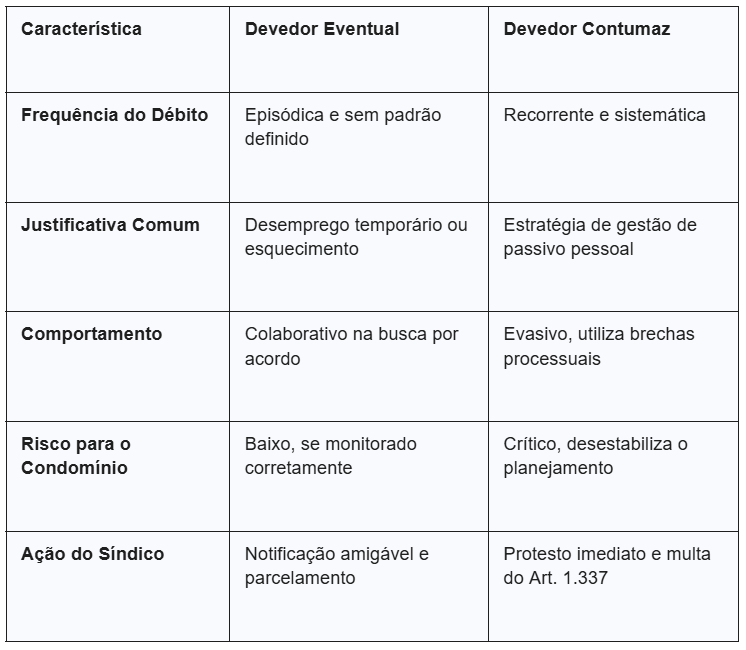
Identifying the habitual defaulter is the first step towards applying the more severe sanctions set out in the Civil Code. This profile, often described as a "harmful co-owner" in case law, causes damage that goes beyond the financial, as it fosters a sense of impunity that can encourage other residents to also fall behind on payments, creating a vicious cycle of falling property values.
The Habitual Defaulter and Punishment under Article 1,337 of the Civil Code
Brazilian legislation draws a clear distinction between the late-payment fine, applied simply for being behind on payments, and the sanctioning fine, aimed at punishing the repeated failure to fulfil obligations. While Article 1,336, paragraph 1 of the Civil Code caps the late-payment fine at 2% of the debt amount, Article 1,337 opens up a much stricter range of penalties for the co-owner who repeatedly fails to meet their obligations to the community.
According to the main text of Article 1,337, a co-owner or occupant who repeatedly fails to meet their obligations may, by resolution of three-quarters of the remaining co-owners, be compelled to pay a fine of up to five times the monthly contribution amount, depending on the severity and repetition of the breaches. The STJ has already settled the understanding that habitual late payment falls into this category, allowing the 2% fine to be combined with this punitive penalty.
To correctly apply this fine, a strict procedure must be followed to avoid it being overturned in court:
Establishing Repetition: The building manager must document that the delay is not an isolated incident but a repeated pattern of conduct that burdens the other residents.
Right to a Defence: The condominium cannot apply the fine without giving the resident the chance to defend themselves before the general meeting.
Notice and Quorum: The general meeting must be convened specifically for this purpose, and approval requires a favourable vote from three-quarters of the remaining co-owners (excluding the vote of the offending party).
Proportionality: The amount of the fine (up to 5 times the contribution) must be graded according to the history and severity of the situation.
In addition to the main text, the sole paragraph of the same article deals with the "antisocial co-owner", whose behaviour creates incompatibility with the other residents. In these extreme cases, which may include assaults, unlawful activities or non-payment so severe that it hinders the building's operation, the fine can reach up to ten times the value of the condominium contribution.
The Illegality of Barring Access to Leisure Areas: Limits on Coercive Power

One of the most common mistakes made by building managers and advisory boards, often under pressure from indignant paying residents, is the attempt to bar defaulters from using common areas such as the swimming pool, gym or party room. Although this measure may seem logically fair to some — on the grounds that those who don't pay shouldn't benefit — the Superior Court of Justice has firmly established that such a restriction is unlawful and abusive.
STJ case law, exemplified by REsp 1,699,022 and REsp 1,564,030/MG, is grounded in the indissoluble nature of the organic unity of the multi-owner building. The right to use common areas is inherent to the right of ownership, and to the social function of possession (Article 1,335, II of the Civil Code). The court holds that late payment must be tackled exclusively through financial means, such as fines, interest, protest and judicial enforcement against the property itself.
The main reasons why barring access to leisure areas is a high-risk practice for the building manager are:
Violation of Human Dignity: Preventing access to communal areas exposes the resident and their family (including children) to a humiliating situation in front of neighbours, which can result in hefty damages for moral harm being awarded against the condominium.
Absence of Legal Backing: The Civil Code sets out specific financial sanctions for non-payment; restricting use is not among the penalties permitted by the legislator.
Abuse of Rights: Using the denial of leisure facilities as a means of coercing payment is considered a misuse of condominium rules.
Therefore, instead of resorting to unlawful punitive measures, the modern building manager should focus on procedural speed. Under the new Civil Procedure Code, the condominium contribution has become an extrajudicial enforcement instrument, allowing judicial collection to take place much more quickly, reaching seizure and auction of the unit within shorter timeframes.
Ethics and Responsibility of the Building Manager in Debt Collection
Managing late payment requires the building manager to strike a delicate balance between the firmness needed to protect the condominium's cash flow and the ethical sensitivity to respect individual rights. Collection carried out inappropriately can result in proceedings against the building manager personally, should it be proven that there was an abuse of power or negligence in handling the matter.
Disclosing lists of defaulters is a legal minefield. Although the building manager has a duty to give an account and inform the general meeting of who is in debt, this information must be handled with technical discretion. Recent 2024 and 2025 case law suggests that it is lawful to list indebted units on bills or internal statements, provided access is restricted to co-owners and does not allow third parties or visitors to view it.
The building manager must remember that their role is administrative, not inquisitorial. By keeping a rigorous record of every attempt at contact and negotiation, the manager protects the condominium legally and demonstrates professionalism before the audit committee and the general meeting.
Energy Efficiency and Cutting Fixed Costs with NewSun Energy Group

In the context of financial management, prevention is just as important as recovery. Reducing the condominium's fixed expenses is one of the most effective ways of mitigating the damage caused by late payment. When the condominium operates with a leaner cost structure, one or two units failing to pay does not immediately jeopardise staff wages or lift maintenance.
The electricity bill is historically one of the biggest drains on the budget, accounting for up to a quarter of the total expenses for common areas. This is where the innovation of NewSun Energy Group acts as a strategic ally for the building manager. Through the subscription energy model, the condominium starts receiving credits that reduce the value of the local utility bill.
The benefits of this energy transition are tangible and immediate:
Real savings: The reduction in the energy tariff frees up resources that can be used to strengthen the reserve fund or invest in improvements.
No structural works: Unlike installing solar panels, which requires approval by a special quorum for works and a high upfront investment, NewSun's energy subscription requires no physical alteration to the building or capital outlay.
Budget predictability: In a scenario of tariff instability and scarce pricing flags, solar energy offers a more stable cost, making it easier for the building manager to draw up the annual budget plan.
Asset appreciation: Condominiums that adopt ESG (Environmental, Social and Governance) practices are more highly valued in the property market.
By cutting fixed costs, the building manager reduces the pressure for increases to the condominium contribution, keeping payment compliance at healthy levels and ensuring the development's financial sustainability.
Procedural Strategies and the Use of the New Civil Procedure Code in Debt Recovery
When friendly measures and the fines under Article 1,337 fail to work, the condominium must turn to the courts without delay. The 2015 Civil Procedure Code brought a fundamental advance by classifying condominium contributions as extrajudicial enforcement instruments, (Article 784, X). This means the condominium no longer has to go through a lengthy fact-finding stage to prove the debt exists; it can proceed directly with enforcement proceedings.
Under this procedure, the debtor is summoned to pay within three days, under penalty of immediate seizure of assets. One of the condominium's most powerful guarantees is that the indebted unit itself is liable for the debt, and Brazilian courts have already settled that the property can be auctioned even if it is the defaulter's only family home (Law 8,009/90).
To maximise the efficiency of judicial collection, the building manager must ensure that:
Meeting Minutes are Up to Date: The minutes approving the budget forecast are an essential document for enforcement proceedings.
Bylaws and Regulations are Updated: Having the penalties under Article 1,337 set out in the bylaws makes it easier to collect these sanctioning fines through the courts.
Specialist Legal Advice: Guidance from lawyers who understand the nuances of condominium law prevents procedural errors that delay payment.
The combination of registering a protest, which restricts the debtor's credit almost instantly, with strategic judicial enforcement forms the most successful pairing for reducing habitual late payment.
The Building Manager's Role as an ESG Manager and Social Harmoniser
The 21st-century building manager must view the condominium as an ecosystem where financial health and social peace are interdependent. Governance based on ESG (Environmental, Social and Governance) pillars is the way to reduce housing stress and late payment. By adopting clean, affordable energy with NewSun, the manager addresses the Environmental and Economic pillar. By carrying out ethical collection and respecting the STJ's limits on leisure areas, they address the Social and Human pillar.
Absolute transparency in accountability is what underpins this governance. Co-owners who understand where every penny is spent and see the building manager's efforts to cut fixed costs feel more motivated to honour their commitments. Environmental and financial education for residents, fostered by open management, creates a culture of responsibility that isolates the habitual defaulter, making their conduct socially unacceptable to the community.
In short, modern management of late payment is not merely a hunt for defaulters, but a rebuilding of the building's operational efficiency. The building manager who invests in energy sustainability and masters the legal instruments of the Civil Code turns the condominium into a fairer, more valued and financially healthier environment for everyone.
You may also like
- Casos de Sucesso
 20/10/2026
 5m
5m - Dicas para Síndicos e PMES16/10/20265m
- Dicas para Síndicos e PMES13/10/20265m




Stop paying more for your energy bill
Find out in less than 1 minute how much you could save with clean energy every month — no works and no bureaucracy.
Join the energy revolution
Subscribe to our newsletter and receive exclusive content