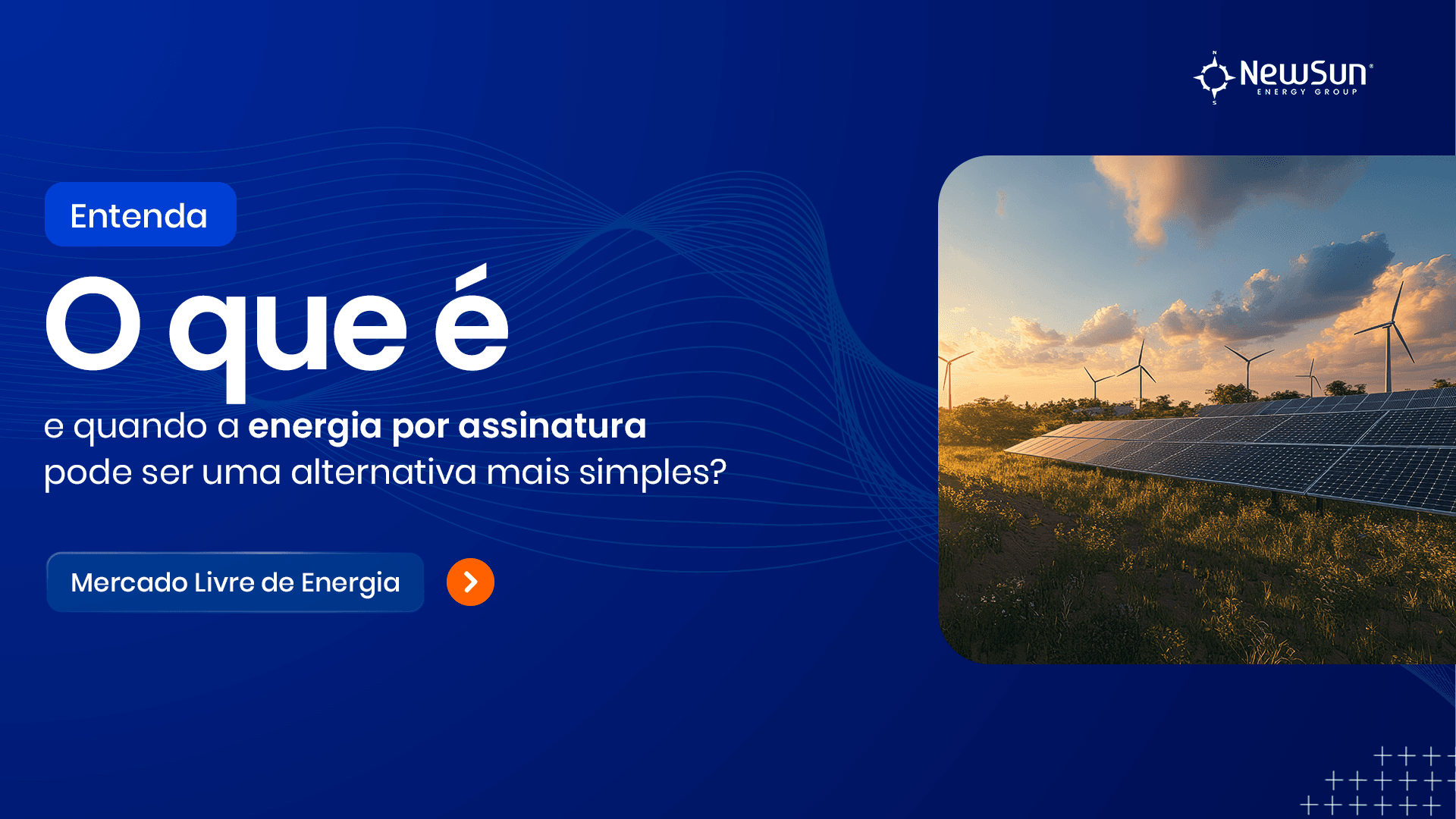
What is the Free Energy Market, and when can energy by subscription be a simpler alternative?
What is the Free Energy Market, and when can energy by subscription be a simpler alternative?
Energia por Assinatura
 10/11/2026
 5 min
For decades, Brazilian consumers’ relationship with electricity followed a fairly simple pattern: businesses received electricity from their local distribution company and paid their bills according to the tariffs regulated by the electricity sector. For most organisations, there was no choice of supplier and no scope to negotiate the commercial terms of their electricity supply.
In recent years, however, this situation has begun to change. The expansion of the Free Energy Market has broadened the contracting options available to thousands of Brazilian businesses, allowing eligible consumers to negotiate electricity purchasing terms directly. This development represents one of the sector’s biggest transformations since the 1990s and continues to progress gradually, reaching an ever-growing number of consumers.
At the same time, other energy solutions have gained ground in the market, particularly those linked to distributed generation and energy subscription models. This means that businesses now have more than one option for modernising their relationship with electricity. They have different paths available, each with its own characteristics, levels of complexity and specific consumption profiles.
Before deciding which model makes the most sense for your business, it is therefore essential to understand how the Free Energy Market works, what its advantages are, who can participate and when solutions such as clean energy subscriptions may offer a simpler, more accessible alternative.
What is the Free Energy Market?
The Free Energy Market, technically known as the Free Contracting Environment (Ambiente de Contratação Livre — ACL), is the market in which eligible consumers can choose whom to buy electricity from and negotiate commercial terms directly with suppliers, energy traders or generators. Under this model, terms such as price, the quantity of electricity contracted, the supply period and the contractual structure can be negotiated.
Rather than purchasing electricity exclusively from the local distribution company, as happens under the traditional model, consumers gain the freedom to seek suppliers offering terms that better suit their consumption profile and business planning. This freedom of choice is regarded as one of the ACL’s most important characteristics and one of the main drivers of its growth in recent years.
It is important to emphasise that the Free Energy Market does not change the physical infrastructure that delivers electricity to consumers. Electricity continues to arrive through the same electricity network and the same regional distribution company. What changes is the commercial relationship associated with purchasing the electricity itself. The distribution company remains responsible for operating the network, maintaining the infrastructure and ensuring the quality of supply.
This is one of the most common sources of uncertainty for those learning about the subject. Many people imagine that moving to the Free Energy Market means changing the electricity network or installing new equipment. In practice, the change mainly concerns how electricity is contracted.
How does the traditional electricity supply model work?

To fully understand the Free Energy Market, it is important first to understand how the Regulated Contracting Environment (Ambiente de Contratação Regulada — ACR), also known as the regulated market or captive market, works.
Under this model, consumers buy electricity from the distribution concessionaire responsible for the region in which they are located. Tariffs and rules are set and overseen by ANEEL, and consumers do not participate directly in negotiating electricity prices.
This is the model that still serves most Brazilian consumers, including households, small businesses and a large proportion of the commercial sector. In this market, the tariff structure is standardised, and adjustments follow regulatory criteria established by the electricity sector.
Consumers in the regulated market are also subject to the tariff flag system, a mechanism that signals more or less favourable electricity generation conditions and may result in temporary surcharges on electricity bills.
Although it is an established and reliable system, it offers less commercial flexibility than the Free Energy Market.
What are the differences between the Free Energy Market and the Regulated Market?
The main difference is freedom of contracting. Whilst consumers in the regulated market buy electricity exclusively from the distribution company responsible for their region, those in the Free Energy Market can negotiate directly with authorised suppliers.
Aspect Regulado (ACR) Mercado Livre (ACL)
Choice of supplier No Yes
Price negotiation No Yes
Tailored contracts No Yes
Choice of energy source Limited Possible under various contracts
Distribution network Local distribution company Local distribution company
Network maintenance Local distribution company Local distribution company
The physical network remains exactly the same under both models. The difference lies in the purchasing arrangements for electricity and the commercial negotiation options available to consumers.
When did the Free Energy Market emerge in Brazil?
The Free Energy Market officially began with the publication of Law No. 9,074/1995, regarded as one of the most important milestones in the modernisation of Brazil’s electricity sector. The legislation created the category of free consumer and initiated the gradual opening of the market.
The aim of the reform was to increase competitiveness, encourage private investment and improve efficiency in the sector. At that time, only large consumers could participate in this market.
Over the following decades, new regulations gradually lowered barriers to entry and increased the number of eligible businesses. Subsequently, the establishment of the CCEE (Electricity Trading Chamber) helped consolidate the electricity trading framework that exists today.
This process continues to evolve. The opening of the market is regarded as a gradual, planned policy, with further stages scheduled for the coming years.
Who can currently participate in the Free Energy Market?
Since January 2024, all consumers connected at medium or high voltage and classified as Group A have been able to move to the Free Energy Market, regardless of their contracted demand.
This includes a range of business types, such as:
Industrial businesses;
Hospitals;
Retail chains;
Universities;
Supermarkets;
Logistics centres;
Hotels;
Schools;
Business complexes;
Shopping centres.
Consumers with a load below 500 kW who wish to enter this market can be represented by retail agents before the CCEE, simplifying participation in the free market.
Will the Free Energy Market continue to open up?
Yes. The federal government and regulatory bodies have been progressing with the gradual expansion of access to the ACL. Decree No. 13,097/2026 established further stages for opening the market to consumers currently supplied at low voltage as well.
According to the rules currently published:
Low-voltage commercial and industrial consumers will be able to exercise this right from November 2027;
Residential consumers are expected to be included from November 2028.
This change could substantially increase the number of consumers eligible to choose their energy suppliers in the future.
Are the Free Energy Market and distributed generation competitors?
Not necessarily. This is one of the most common questions among business owners starting to explore energy alternatives.
The Free Energy Market and distributed generation are different models, designed to meet different needs. Both help modernise consumers’ relationship with electricity, but they operate under different regulatory frameworks.
The ACL is aimed at consumers who wish to negotiate electricity purchase contracts and manage aspects of contracting within the free market.
Distributed generation, on the other hand, uses a mechanism based on offsetting energy credits from renewable power plants connected to the electricity system, following specific rules laid down in sector legislation.
In practice, this means that neither model is a universal winner. There is simply a solution best suited to each consumption profile and business strategy.
Why has energy by subscription attracted so many businesses?
Although the Free Energy Market represents an important development for the sector, many businesses continue to seek solutions that require fewer operational steps and less involvement in migration processes or specialist contract management. It is in this context that interest in energy by subscription based on distributed generation is growing.
The principle is relatively simple: businesses continue to receive electricity as usual from their local distribution company, with no changes to their physical infrastructure, but join a system that uses energy credits produced by renewable power plants participating in the regulated distributed generation model.
This alternative has particularly attracted businesses that value operational simplicity, financial predictability and sustainability, but do not wish to invest in their own electricity generation infrastructure.
How does NewSun’s clean energy subscription work?

NewSun’s clean energy subscription allows businesses to benefit from distributed generation without having to install solar panels, carry out building work or purchase equipment.
Electricity continues to be supplied as usual by the local distribution company. There are no changes to the business’s electricity network or structural alterations to the premises.
Through the energy credit offsetting model provided for in distributed generation regulations, businesses gain access to a solution that combines operational simplicity with more efficient cost management in relation to energy.
Among the distinguishing features most valued by businesses are:
Savings on electricity bills;
Greater financial predictability;
Reduced exposure to the effects of tariff flags on the conventional tariff;
No investment in their own equipment;
No building work required;
No costs for maintaining generation systems.
For many SMEs, retail chains, offices, clinics, distribution centres and commercial operations, this simplicity becomes a decisive factor when choosing an energy solution.
So which model makes the most sense for your business?
The answer depends on the organisation’s profile. Businesses with a suitable level of consumption, an appropriate structure and an interest in operating directly within the ACL may find the Free Energy Market a valuable tool for tailoring their energy strategy and negotiating contracts specific to their needs.
On the other hand, organisations seeking a simpler process, without investing in infrastructure or having to manage energy purchasing processes in the free market, often consider alternatives based on distributed generation subscriptions.
The most important point is to understand that Brazil’s electricity sector is offering consumers an increasing number of options. This represents significant progress for businesses seeking to turn energy into a strategic resource for competitiveness, sustainability and financial planning.
Conclusion
The Free Energy Market is one of the most important transformations in Brazil’s electricity sector in recent decades. Established in 1995 and gradually expanded over the years, it offers eligible consumers the opportunity to negotiate electricity purchases directly, bringing greater freedom and commercial flexibility.
At the same time, the development of distributed generation has created complementary alternatives that simplify access to the benefits of renewable energy for businesses of different sizes.
In this new landscape, understanding the differences between the ACL, the regulated market and energy by subscription has become an increasingly important skill for business owners and managers seeking to make informed decisions about one of the most strategic inputs in today’s business environment.
FAQ
Is the Free Energy Market the same as energy by subscription?
No. The Free Energy Market operates through direct energy contracting with authorised suppliers, whereas energy by subscription uses the energy credit offsetting model associated with distributed generation.
Can any business enter the Free Energy Market?
Currently, consumers classified as Group A (medium and high voltage) can already move to the ACL. For low-voltage consumers, the market will open gradually from 2027.
Does the distribution company stop supplying electricity?
No. The distribution company remains responsible for the electricity network and the physical delivery of electricity under both models.
Does an energy subscription require solar panel installation?
No. Under NewSun’s model, there is no need to buy solar panels, carry out building work or install equipment at the business premises.
Does energy by subscription protect against tariff flags?
The distributed generation framework allows exposure to the effects of tariff flags to be reduced on the offset portion of electricity consumption, contributing to greater predictability in energy costs.
You may also like
- Energia por Assinatura
 10/11/2026
 5m
- Dicas para Síndicos e PMES09/11/20265m
- Dicas para Síndicos e PMES06/11/20265m


Stop paying more for your energy bill
Find out in less than 1 minute how much you could save with clean energy every month — no works and no bureaucracy.
Join the energy revolution
Subscribe to our newsletter and receive exclusive content