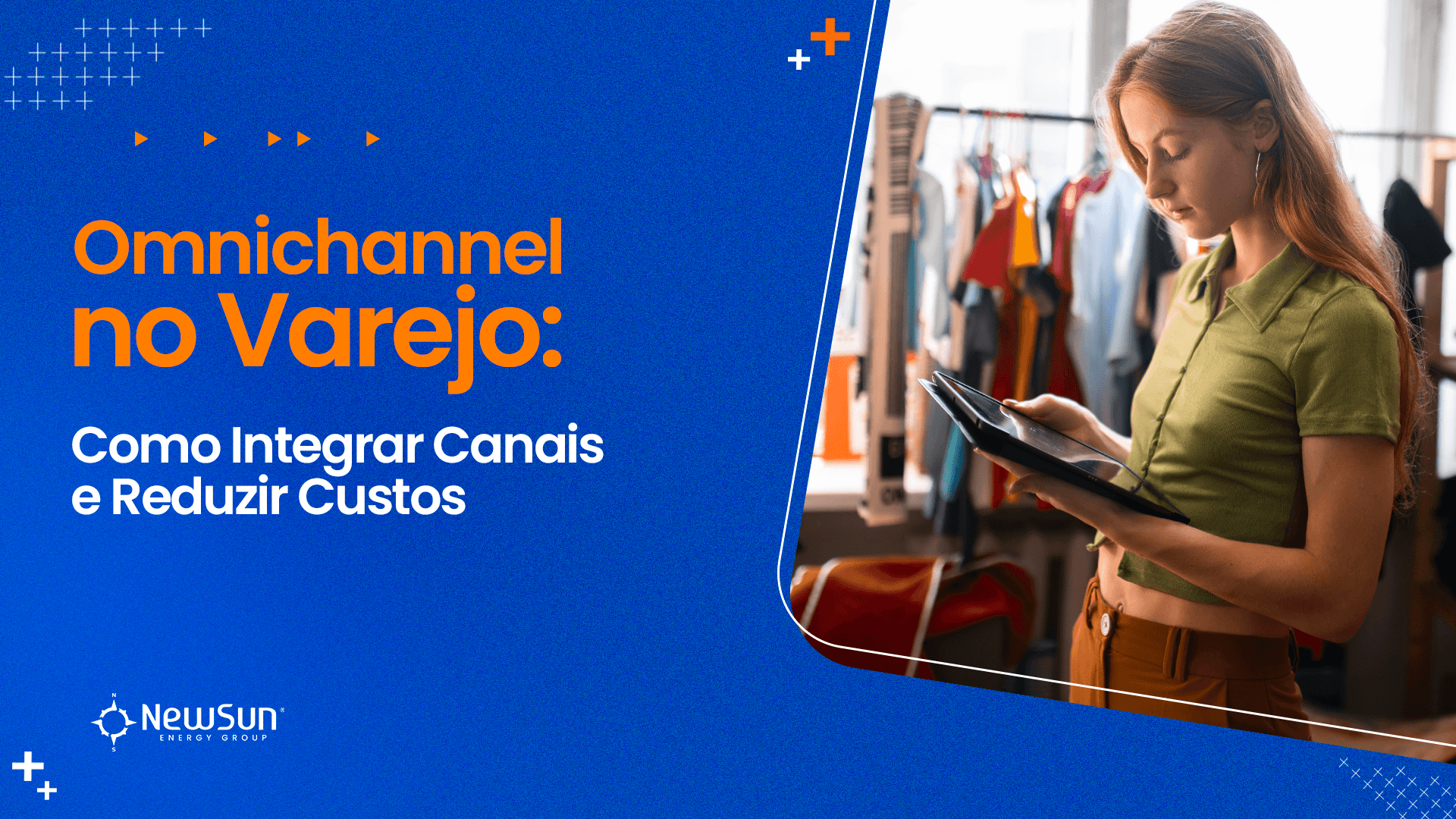
Omnichannel Retail: How to Integrate Channels and Reduce Costs
Omnichannel Retail: How to Integrate Channels and Reduce Costs
Dicas para Síndicos e PMES
 18/08/2026
 5 min
5 minConsumer behaviour has changed irreversibly in recent years. Today’s customer no longer separates the ‘physical world’ from the ‘digital world’ when shopping. They might research a product on their smartphone while walking through a shopping centre, ask the shop a question on WhatsApp, complete the purchase on its website and collect the order from the nearest branch to save on delivery costs.
For owners and directors of small and medium-sized enterprises (SMEs) in the retail sector, this behavioural change creates a clear challenge: the need to adopt omnichannel integration.
Many business owners still mistakenly believe that omnichannel strategies are reserved for retail giants with multimillion-pound technology budgets. In reality, channel unification is a tool for survival and accelerated growth precisely for small and medium-sized retailers, and is key to eliminating stockouts, reducing logistics costs, streamlining operational routines and delighting customers.
This article explains what omnichannel really means, how it can transform the day-to-day running of your business, the specific benefits it offers SMEs, and how to implement the strategy without unnecessary complexity.
What Is Omnichannel? (And How Does It Differ from Multichannel?)

To structure an effective strategy, the first step is to clear up the confusion between Multichannel, Cross-channel and Omnichannel.
Single-channel Retail: The traditional model in which a business has only one point of contact with the customer, such as a physical shop or a website.
Multichannel Retail: The business sells through several channels, such as a physical shop, an e-commerce website, Instagram and online marketplaces. However, these channels operate separately and compete with one another. Website and in-store stock are not connected, prices and promotions differ, and customers cannot return or exchange an online purchase in a physical shop.
Cross-channel Retail: There is some crossover between channels. The customer buys online and collects in store, but the back-office systems still operate with limitations and manual processes.
Omnichannel Retail: This is the complete and seamless integration of all the company’s sales, communication and logistics channels. In an omnichannel ecosystem, the boundaries between physical and digital disappear. Stock is unified in real time, customer history is centralised in a single database, and consumers enjoy a fluid and continuous brand experience, regardless of how they choose to buy, pay for or receive their product.
In short, in multichannel retail a company has several channels; in omnichannel retail, the company offers one coherent experience delivered through multiple touchpoints.
How Omnichannel Integration Transforms Day-to-Day Organisation and Convenience in Retail
Beyond its positive impact on sales, the greatest day-to-day benefit of omnichannel for retailers lies in the simplification and automation of operational management.
When an SME’s channels are disconnected, day-to-day operations can quickly become chaotic: staff have to update spreadsheets manually at the end of the day, check stock across several systems, handle complaints after out-of-stock products have been sold, and reconcile duplicate transactions.
Centralising and integrating management systems brings immediate convenience to the daily workflow:
1. An End to “Phantom Stock” and Lost Sales
Decentralised data is the main cause of the dreaded phantom stock problem, when the system indicates that a product is available even though it has already been sold through another channel. By integrating an ERP system (Enterprise Resource Planning) with the physical shop’s point-of-sale system and digital platforms, stock is deducted instantly across all channels whenever a sale is completed. If the final unit of a shirt is sold at the shop counter, the listing on the e-commerce site and online marketplaces is paused automatically at the same moment.
2. Unified Stock and Turning the Physical Shop into a Logistics Hub (Ship-from-Store)
Rather than tying up working capital in two separate warehouses, one for the physical shop and another for e-commerce, the SME adopts the concept of Unified Stock. The physical shop itself becomes a small local distribution centre. If a nearby customer orders through the website, the product can be taken directly from the shop shelf for express delivery by courier, dramatically reducing delivery time and cost.
3. A Unified Customer View (Integrated CRM)
With channel integration, the customer’s purchase history, preferences, exchanges and interactions are recorded in a single customer profile within the system. When the customer enters the physical shop, a sales assistant equipped with a business tablet or smartphone can see that the customer bought a pair of trousers online the previous week and suggest a matching belt in person. This personalised service increases average transaction value and strengthens loyalty.
4. Efficient Customer Service and Financial Reconciliation
Centralised communications prevent customers from having to repeat their story at every contact. Messages sent via WhatsApp, Instagram, email or in person are stored in the same history. In addition, the SME’s finance department gains agility because payments and tax invoices are reconciled and issued through a central platform.
Specific Advantages of Omnichannel for Small and Medium-sized Enterprises

Many small and medium-sized retailers believe they lack the scale to compete with large national retail chains. An omnichannel strategy is precisely the tool that levels the commercial playing field, enabling SMEs to capitalise on their greatest strengths: customer proximity, agile decision-making and a physical presence in the community.
Optimising Physical Space and Attracting Footfall (BOPIS / Click & Collect)
The Buy Online, Pick Up in Store (BOPIS) model, or simply Buy Online and Collect in Store, is one of the most profitable pillars of omnichannel for SMEs. It removes delivery charges for the customer and creates an enormous commercial benefit for the retailer: qualified footfall inside the physical shop.
Retail industry studies indicate that around 35% to 40% of customers who visit a physical shop to collect a product purchased online end up buying an additional item at the time of collection, boosting cross-selling.
Higher Conversion Rates and LTV (Lifetime Value)
The omnichannel consumer buys more frequently and spends substantially more than the single-channel consumer. By offering flexible purchasing, payment and delivery options, the SME reduces e-commerce basket abandonment and overcomes objections at the physical point of sale. If a specific shoe size is out of stock on the shop floor, the sales assistant can complete the sale at the counter using stock from the e-commerce operation or another branch, securing the sale immediately.
Reducing Customer Acquisition Costs (CAC)
Advertising on social media and search engines to attract customers exclusively to a website requires increasing investment in paid media. When an SME integrates its physical shop with the digital environment, for example by using tools such as Google Business Profile and geolocated digital shop windows, it attracts consumers who are physically close to the premises, reducing Customer Acquisition Cost (CAC) and increasing return on advertising investment.
Practical Step-by-Step Guide: How to Implement an Omnichannel Operation in Your SME
The transition to an omnichannel operation need not, and should not, happen all at once. The best approach for small and medium-sized enterprises is gradual implementation, focused on validating each stage before moving on to the next.
Follow this strategic roadmap to structure integration in your business:
Step 1: Map Your Customer’s Current Journey
Before purchasing any technology, analyse how your current customers interact with your brand.
Do they usually ask questions on WhatsApp before visiting the physical shop?
Do they browse the catalogue on Instagram?
Do they ask whether they can buy online and collect at the counter?
Identifying the touchpoints most frequently used by your customers will show where integration should begin.
Step 2: Adopt an Integrating ERP with Unified Stock
Technology is the backbone of omnichannel. The SME’s most important step is to move away from legacy systems that do not communicate and adopt a cloud-based retail ERP with native API integration for leading e-commerce platforms, marketplace hubs and point-of-sale systems.
Ensuring that the system automatically synchronises stock, prices and tax invoices is essential to preventing operational failures.
Step 3: Implement “Buy Online and Collect in Store” (Click & Collect)
Begin integrating channels with the solution that combines the lowest technical complexity with the greatest sales impact: in-store collection.
Create an organised physical collection point at your premises, or brief the counter team.
Train employees to ensure that the product is packaged and labelled as soon as the system issues the payment confirmation.
Ensure that the collection experience is fast and courteous, using the opportunity to present complementary products to the customer.
Step 4: Standardise Exchange and Customer Service Policies
One of the greatest customer frustrations is being told in a physical shop that a product purchased on the company’s own website “cannot be exchanged at the counter”.
Align legal and operational procedures to authorise unified exchanges through any channel.
Simplify the returns process, viewing an exchange not as a cost but as an opportunity to retain the customer and generate a new purchasing cycle.
Step 5: Train and Engage the Sales Team (Unified Commission)
Resistance from shop-floor sales staff is one of the greatest barriers to omnichannel success in SMEs. If a sales assistant sees e-commerce as a “competitor” that takes away commission, they will discourage customers from using digital channels.
The solution is to create a unified or collaborative commission policy:
Pay commission to the shop-floor sales assistant when they help a customer in store complete an e-commerce purchase because the product is unavailable on the shelf.
Award credits or bonuses to the physical shop team for Click & Collect orders collected from the premises, engaging the whole team in the success of the customer’s overall journey.
Seamless Total Integration: How NewSun’s Subscription Energy Connects Sustainability and Financial Predictability in Retail

Just as an omnichannel strategy removes barriers and friction between physical and digital commerce to ensure maximum operational efficiency, retail financial management requires business owners to eliminate noise and invisible leakage from their fixed-cost structure.
In retail operations, whether high-street shops, shopping-centre premises or distribution warehouses, electricity is one of the largest daily operating expenses. Keeping sales floors lit with high-powered feature lighting to showcase window displays, running air-conditioning continuously for customer comfort, and operating computers, refrigerated counters and servers without interruption consumes a substantial amount of electricity throughout the month.
However, for SME owners seeking to protect their profit margin, managing electricity costs runs up against the Force of Unpredictability. Historically, periods of drought lead ANEEL to activate tariff flags, yellow or red, causing unexpected spikes in the rates charged by local distributors. This fluctuation creates cash-flow instability, undermines financial predictability and reduces the SME’s capacity to invest in the development of new sales channels.
To break this cycle of uncertainty and apply the same intelligent approach to integration to your budget, NewSun has developed a revolutionary solution: clean energy by subscription.
NewSun’s proposition is a perfect example of frictionless efficiency for modern retail:
No Building Work or Refurbishment: Just as omnichannel simplifies the customer journey, NewSun simplifies the energy transition. Your shop or warehouse does not need to alter its electrical system, break through masonry or install equipment on the premises.
Zero Upfront Investment (Zero CAPEX): You do not need to tie up your SME’s working capital by purchasing solar panels or inverters. Your cash remains available for investment in stock, marketing and sales technology.
Zero Maintenance Worries: NewSun is fully responsible for the technical management, operation and maintenance of the distributed-generation plants.
Our work is structured around the pillars of the 5D Matrix:
Cut Red Tape: A fast, 100% digital sign-up process without inflexible contracts.
Decentralise: We connect your commercial premises directly to distributed clean-energy generation.
Digitise: An intuitive platform for monitoring energy credits and savings in the palm of your hand.
Decarbonise: Real, practical sustainability that reduces your brand’s carbon footprint and attracts environmentally conscious consumers.
Decommoditise: We transform the electricity bill from a passive, unpredictable charge into a strategic tool for budget efficiency, with competitive rates and guaranteed progressive savings.
By subscribing to clean energy with NewSun, you eliminate financial unpredictability from your electricity bills and free up budget margin to invest in the digital transformation and omnichannel expansion of your business.
Conclusion
Omnichannel integration is no longer a future trend; it has become a basic requirement for survival and competitiveness in contemporary retail. For small and medium-sized enterprises, connecting physical and digital channels is the smartest strategy for optimising stock use, turning the physical shop into a logistics and experience point, reducing delivery costs and increasing customer lifetime value (LTV).
By adopting an integrated management system, focusing on simple solutions such as Click & Collect, and aligning the team’s commission policy, the SME removes internal barriers and delivers the convenience modern consumers demand.
Likewise, extending this mindset of efficiency and friction removal to the management of the company’s fixed costs, by subscribing to NewSun energy to neutralise tariff spikes and ensure budget stability, consolidates modern business leadership focused on innovation, genuine sustainability, and the continuous and profitable growth of the business.
You may also like
- Energia por Assinatura
 02/10/2026
 5m
5m - Energia por Assinatura01/10/20265m
- Dicas para Síndicos e PMES30/09/20265m




Stop paying more for your energy bill
Find out in less than 1 minute how much you could save with clean energy every month — no works and no bureaucracy.
Join the energy revolution
Subscribe to our newsletter and receive exclusive content