

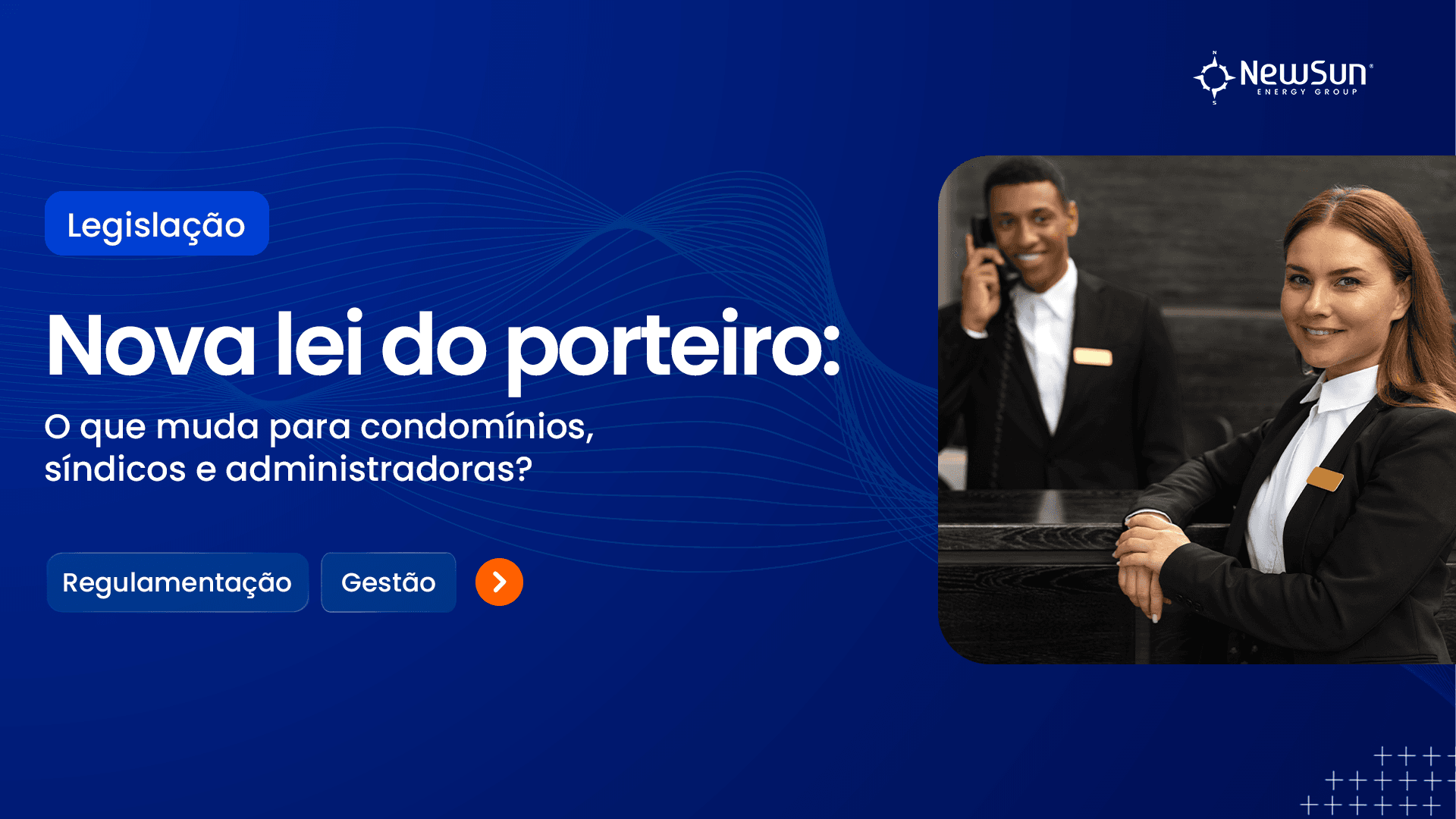
New concierge law: what changes for condominiums, property managers and management companies?
New concierge law: what changes for condominiums, property managers and management companies?
Dicas para Síndicos e PMES
 08/10/2026
 5 min
5 minSecurity has always been one of the greatest concerns for residents, property managers and condominium management companies. In many Brazilian developments, especially small and medium-sized ones, operational routines have created a common situation: concierges carrying out activities that, in practice, were close to the duties of property security guards.
For years, this overlap of responsibilities was regarded as natural. The same professional who controlled access also carried out patrols, monitored common areas with a focus on preventing intrusions and, in some cases, acted directly in situations related to asset protection.
In recent years, however, the subject has received more attention from the authorities responsible for supervising private security. The result was the consolidation of clearer rules through the Private Security Statute, established by Law No. 14,967/2024 and later regulated by Decree No. 13,012/2026, as well as supplementary rules published by the Federal Police.
In practice, the change does not abolish the concierge profession or prevent concierge services from continuing. The main aim is to clearly define which activities belong to concierge services and which are considered private security services.
For property managers and management companies, understanding these changes has become essential to avoid labour risks, regulatory issues and future penalties.
What is the Private Security Statute?
The Private Security Statute is a new regulatory framework created to modernise the legislation governing private security services in Brazil.
According to information published by outlets such as UOL, R7 and O Tempo, the legislation replaces the previous legal structure based on Law No. 7,102/1983 and establishes more detailed rules for the work of security guards, security companies and in-house asset protection services.
One of the statute’s main concerns was precisely to clarify which activities constitute private security and which remain classified as administrative or operational support functions.
It was in this context that the clearer separation between concierge and security guard emerged.
Why was this change approved?

The legislation was approved amid discussions about professionalisation, oversight and legal certainty in private security services.
In practice, there were situations in which workers hired as concierges ended up performing typical surveillance activities without having the specific training or professional classification required for that role.
This raised questions related to professional qualifications, operational security and the responsibilities of those hiring the services.
The new regulations seek to correct this scenario by establishing more objective criteria for each activity. In this way, a clearer dividing line is created between the professional responsible for access control and the one prepared to act in the active protection of people and property.
What can the concierge continue to do?
One of the most frequent questions among property managers is whether concierges can continue to perform their duties as normal.
The answer is yes.
The legislation preserves traditional concierge activities and makes it clear that they should not be confused with private security services.
The duties that remain permitted include:
Controlling residents’ entry and exit;
Controlling visitors and service providers;
Identifying people;
Controlling vehicles;
Receiving parcels;
Operating gates;
Reporting suspicious situations;
Providing service at the concierge desk;
Passive monitoring of surveillance cameras.
These activities continue to be considered typical concierge functions and do not require registration as a security guard.
What does passive monitoring mean?
This is an important point for condominiums.
The new regulations do not prevent the concierge from following camera footage or observing movement around the development.
According to guidance highlighted in reports based on the regulatory decree, passive monitoring remains permitted. The professional may observe and report abnormal situations to those responsible or to the competent authorities.
The problem arises when the activity ceases to be observation and starts to involve action typical of private security.
What can the concierge no longer do?
This is precisely where the main practical change for condominiums lies.
The new regulations make it clear that certain activities are exclusive to duly qualified security guards.
These include:
Property security patrols;
Active protection of residents;
Active protection of property;
Approaching suspicious people;
Physical restraint of individuals;
Private searches;
Preventive or repressive interventions related to security;
Property surveillance activities.
In other words, the concierge may observe and report. What they cannot do is take on the role of a property security agent.
This distinction is considered one of the pillars of the current regulations.
Can a concierge carry out patrols?

This is probably the question that has generated the most uncertainty in the condominium market.
According to the regulations described by the Private Security Statute and the Federal Police’s supplementary rules, patrols carried out for the purpose of asset protection are considered a typical surveillance activity.
Therefore, when the purpose of the patrol is to prevent intrusions, deter theft or protect property, the activity requires a professional classified as a security guard.
This means that many condominiums will need to review internal procedures that have historically assigned this role to concierges.
What differentiates a concierge from a security guard?
The main difference lies in the purpose of the activity performed.
The concierge works in access control and concierge operations. The security guard, on the other hand, works directly in the protection of people and property.
In addition, the security guard must meet specific requirements set out in legislation.
According to reports published by several national outlets, the private security professional must undergo specific training recognised by the Federal Police, including content related to property surveillance, approaching people, first aid and emergency procedures.
When do the new rules come into force?
The legislation had already come into force, but the recent regulations set deadlines for the sector to adapt.
According to information published by outlets such as O Tempo and Revista Segurança Eletrônica, condominiums have a transition period to adapt their operations, with a deadline extending to September 2027 for certain adjustments related to private security services.
This does not mean that managers should wait until then to act.
Industry specialists have been recommending that property managers and management companies immediately begin reviewing procedures, contracts and employees’ job descriptions.
How does this change day-to-day building management?
The change requires a more careful analysis of the condominium’s operational routines.
Many managers will need to review internal rules, outsourcing contracts and the activities assigned to concierge teams.
Some questions that now become relevant include:
Are property patrols being carried out by concierges?
Does the concierge team receive instructions to approach suspects?
Are the duties described in the contracts compatible with the legislation?
Are there outsourcing arrangements that need to be reviewed?
Does the condominium have a real need for specialised property security?
Answering these questions helps reduce future risks and increases operational compliance.
In addition, management companies will need to play an important role in guiding property managers on the necessary adaptations.
How NewSun’s clean energy subscription helps reduce costs and bureaucracy

While managers deal with regulatory matters, security, maintenance and relationships with residents, the search for financial efficiency remains a constant priority.
In this context, NewSun’s clean energy subscription emerges as an alternative for condominiums that want to simplify energy management without carrying out works or purchasing equipment.
The model was developed to reduce the bureaucracy normally associated with own-generation energy projects. There is no need to install solar panels in the condominium or invest in its own infrastructure. The distributor’s supply continues to operate normally.
In addition to operational simplicity, the solution helps property managers and management companies seek greater predictability in costs related to electricity, one of the most significant expenses for common areas.
Thus, while the manager focuses their attention on the condominium’s new regulatory and operational requirements, energy management can continue in a more practical, organised way that is aligned with sustainability principles.
The new legislation reinforces the professionalisation of the sector
Rather than creating limitations, the regulations seek to establish clear criteria for roles that have historically been confused in many developments.
The concierge continues to play a fundamental role in the routine of condominiums. What has changed is the more precise definition of the boundaries between access control and property surveillance.
For property managers and management companies, this is a moment for adaptation and planning. Assessing procedures, reviewing contracts and understanding the new responsibilities will help avoid future problems and ensure operations are more closely aligned with legal requirements.
In a context of increasing professionalisation in condominium management, knowing the legislation and acting preventively remains one of the best ways to protect property, reduce risks and offer residents greater security.
Therefore, the difference lies not only in the job title recorded, but mainly in the nature of the activities performed.
You may also like
- Dicas para Síndicos e PMES
 08/10/2026
 5m
5m - Dicas para Síndicos e PMES06/10/20265m
- Dicas para Síndicos e PMES05/10/20265m




Stop paying more for your energy bill
Find out in less than 1 minute how much you could save with clean energy every month — no works and no bureaucracy.
Join the energy revolution
Subscribe to our newsletter and receive exclusive content