
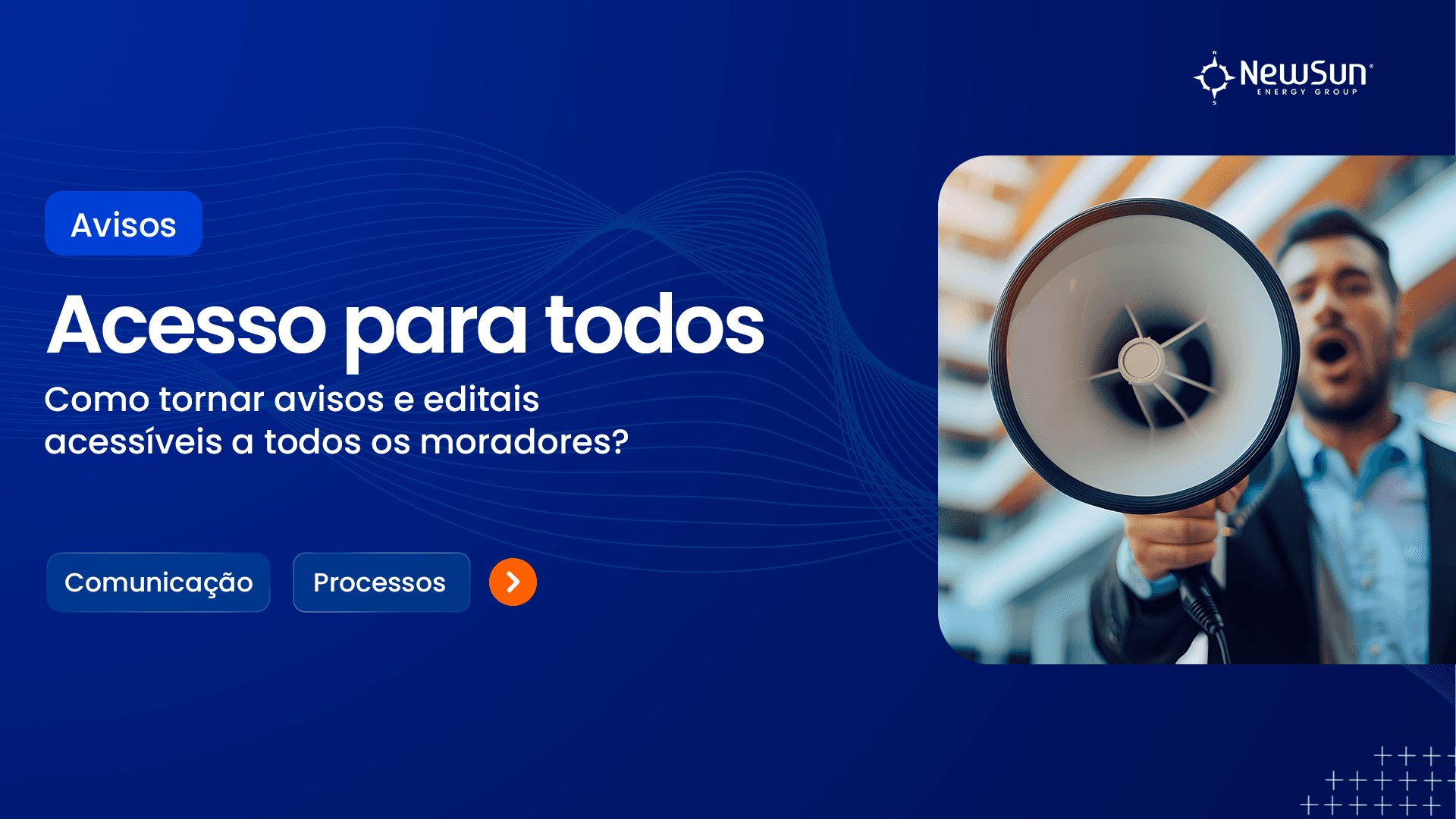
How to Ensure Notices and Announcements Are Accessible to All Residents in a Condominium
How to Ensure Notices and Announcements Are Accessible to All Residents in a Condominium
Dicas para Síndicos e PMES
 05/10/2026
 5 min
5 minGood condominium management depends on many factors: financial organisation, efficient maintenance, security and relationships with residents. However, there is one frequently overlooked aspect that directly affects residents’ participation in the life of the development: communication accessibility.
Notices, announcements, meeting calls, operational communications and information about works or maintenance need to reach all residents effectively. When part of the population faces barriers to accessing this information, management risks creating unintentional exclusion, reducing participation in decision-making and even raising questions about administrative transparency.
This challenge becomes even more relevant when we consider the diversity found in modern condominiums. In addition to residents with visual, hearing, intellectual or mobility impairments, there are differences related to age, digital habits, professional routines and information-consumption preferences. A notice displayed only on a noticeboard, for example, may not reach a resident who spends most of the day away from home. Likewise, an exclusively digital message may not adequately serve certain age groups.
Creating accessible communication does not simply mean meeting legal requirements or adopting inclusive practices. It means ensuring that all residents have equal access to information that influences their life within the condominium.
What does accessibility in communication mean?
Accessibility in communication consists of removing barriers that make it difficult for people with different physical, sensory, cognitive or behavioural characteristics to access information.
In the condominium environment, this means developing strategies so that notices, announcements and meeting calls can be understood by as many residents as possible, regardless of visual, hearing, mobility or cognitive limitations.
The Brazilian Inclusion of Persons with Disabilities Act (Law No. 13,146/2015) establishes principles related to accessibility and the right of access to information, reinforcing the need to remove communication barriers in various areas of society.
For property managers and management companies, accessibility should not be seen merely as an obligation. It represents an opportunity to strengthen relationships with the community and increase residents’ participation in condominium management.
Why is accessible communication important for the condominium?

When a communication is not accessible, the consequence goes beyond simply being uninformed. Imagine a meeting call displayed on an internal noticeboard without any digital supplement. Residents with visual impairments may have difficulty reading the material, while residents who work away from home for much of the day may never even pass by the place where the notice was posted.
Now imagine an announcement sent only as a written message in an app. A resident with a hearing impairment will be able to access the content, but a person with a visual impairment will depend on the material being compatible with screen readers or on an accessible alternative being available.
In both cases, part of the community ends up at a disadvantage.
Inclusive communication strengthens governance, reduces conflicts, increases transparency and helps collective decisions better reflect the condominium’s reality.
How to make communications accessible for people with visual impairments
Residents who are blind, have low vision or have other conditions that make reading difficult require special attention when materials are prepared.
Use legible fonts and appropriate contrast
One of the most common mistakes is using small lettering or colour combinations that make reading difficult. Light grey text on a white background, for example, can pose a significant challenge for people with low vision. The greater the contrast and the cleaner the layout, the more legible the material tends to be. It is also advisable to use simple, well-defined fonts, avoiding overly decorative styles.
Provide digital versions compatible with screen readers
Many blind people use screen-reader software to access digital content. For this reason, PDFs scanned as images can create significant barriers. Ideally, documents should be provided in accessible formats that allow proper reading by the assistive tools used by residents. Whenever possible, communications should be made available in editable formats compatible with accessibility technologies.
Consider audio versions
Important meeting calls, assembly announcements and relevant communications can also be made available in audio format. This practice significantly broadens access to information and can benefit not only people with visual impairments, but also older residents or those who prefer to consume content in this way.
How to ensure accessibility for deaf residents

The deaf community is highly diverse. Some people use Brazilian Sign Language (LIBRAS) as their main form of communication, while others prefer written communication. For this reason, it is important to use a multifaceted approach.
Prioritise objective and clear messages
Overly complex texts make comprehension difficult for any audience, including deaf residents. Using direct language, short sentences and information organised in bullet points significantly facilitates understanding. The simpler and more objective the communication, the more effective it will be.
Consider LIBRAS materials for relevant topics
For high-impact assemblies or important institutional communications, providing videos with LIBRAS interpretation can be an extremely inclusive solution. Although it is not necessary for every routine communication, this practice reinforces the condominium’s commitment to accessibility.
What about residents with mobility impairments?
Accessibility also involves the way notices are physically distributed.
Residents who use wheelchairs, people with reduced mobility or individuals with dwarfism may face difficulties when noticeboards are installed in unsuitable positions.
Review the height of noticeboards
Noticeboards should be positioned so that they can be viewed by different resident profiles. When all information is placed in high locations, part of the population may encounter obstacles to consulting communications independently. Installing multiple communication points or using digital resources can complement this need.
Avoid relying exclusively on physical communication
Accessible communication depends on channel redundancy. If a single noticeboard is the condominium’s main source of information, any physical limitation related to access to that space may lead to exclusion. For this reason, it is advisable to combine in-person and digital communication.
Accessible communication goes beyond people with disabilities

A common mistake is to associate accessibility only with people with disabilities. In practice, different behavioural profiles also require varied communication strategies. Some residents check apps daily. Others prefer emails. Some pay more attention to internal information groups. There are also those who frequently check physical noticeboards.
Effective communication takes all these behaviours into account.
The most important rule: use multiple channels
The best strategy for ensuring that information reaches the entire community is to diversify the means of communication.
No single channel can reach 100% of residents with the same efficiency.
Therefore, whenever possible, management should combine:
Physical noticeboards;
Condominium apps;
Emails;
Messages on digital platforms;
Printed communications;
Informational audio messages;
Explanatory videos;
Communications in common areas.
When the same information is distributed through different channels, the likelihood of reaching residents increases significantly.
How to make announcements and meeting calls more accessible

Assemblies are one of the most important moments in condominium governance. For this reason, their calls deserve special attention.
Publish in advance
Advance notice allows residents to organise their schedules and also gives time for materials to be adapted when necessary. People who depend on assistive technologies or specialised support may need more time to access certain information.
Structure the content in blocks
Long and visually confusing meeting calls reduce engagement.
Ideally, the document should be organised into clear sections containing:
Date;
Time;
Place;
Method of participation;
Agenda;
Additional guidance.
This makes reading easier for all resident profiles.
Use simple language
Simplicity benefits the whole community. Overly legalistic or bureaucratic texts can hinder understanding even among residents without disabilities. Clear communication reduces doubts, increases participation and strengthens management transparency.
The role of technology in democratising communication
Technology has become a major ally of accessibility. Condominium apps, digital platforms and automation tools make it possible to distribute content in different formats simultaneously. In addition, features such as automatic reading, text enlargement, video subtitles and compatibility with screen readers make the experience more inclusive.
For property managers and management companies, investing in technology means broadening reach without necessarily increasing the operational complexity of management.
How NewSun’s clean energy subscription simplifies the property manager’s routine

In a scenario in which property managers and management companies deal daily with communication, maintenance, contracts, assemblies and resident relations, any process that reduces bureaucracy tends to generate significant benefits for management.
NewSun’s clean energy subscription was created precisely to simplify one of the condominium’s most important areas: energy management. Unlike solutions that require equipment purchases, installation of proprietary systems or construction works, the model allows condominiums to access clean energy without the need for investment in physical infrastructure or equipment acquisition.
Another important advantage is predictability. Instead of continuously facing the Force of Unpredictability, property managers and management companies gain access to a more transparent and organised energy experience. The solution also includes a progressive discount model, allowing the manager to monitor its progress practically and without increasing the condominium’s operational complexity.
Within the NewSun Energy Ecosystem, the focus goes beyond savings. The proposal seeks to reduce bureaucracy in the relationship with energy, digitise processes and deliver a Superior Energy Experience. In this way, the manager gains more time to dedicate to what really matters: enhancing the value of the property, relationships with residents and the sustainable evolution of the condominium.
Creating a culture of inclusion in the condominium
Accessible communication should not be treated as a one-off action. The most modern condominiums are incorporating inclusion as part of their organisational culture. This means considering diversity from the planning of assemblies to the drafting of the simplest day-to-day communications. When the property manager shows genuine concern for ensuring that all residents have access to information, a more collaborative, transparent and participatory environment is created. More than complying with protocols, management strengthens the community’s sense of belonging.
Conclusion
Ensuring that notices, announcements and communications are accessible to all residents is one of the most effective ways to promote inclusion, transparency and good governance within condominiums. People with visual, hearing or mobility impairments have specific needs that must be considered when communication is developed. At the same time, residents with different habits, routines and preferences also require diversified strategies so that information reaches the entire community.
Combining multiple channels, simple language, accessible formats and technological support makes it possible to create truly democratic communication. And when all residents can access information equally, the condominium becomes not only more efficient, but also more human.
You may also like
- Dicas para Síndicos e PMES
 05/10/2026
 5m
5m - Energia por Assinatura02/10/20265m
- Energia por Assinatura01/10/20265m


Stop paying more for your energy bill
Find out in less than 1 minute how much you could save with clean energy every month — no works and no bureaucracy.
Join the energy revolution
Subscribe to our newsletter and receive exclusive content