

How to calculate the default margin in a condominium
How to calculate the default margin in a condominium
Dicas para Síndicos e PMES
 27/03/2026
 5 min
5 minIn the current Brazilian economic climate, one of the biggest challenges facing property managers is payment default, which directly affects cash flow and the development's capacity to invest. Understanding how to calculate the default margin is not merely a mathematical exercise; it is a fundamental governance measure to ensure that ordinary bills are paid without resorting to bank loans or emergency extra levies, which tend to generate significant friction among residents.
Rigorous monitoring of this indicator allows the property manager to anticipate crises and protect paying residents, who, in the absence of a well-planned safety margin, end up covering the shortfall left by defaulters. This report details the fundamentals of payment default in the condominium sector, the precise methods for calculating the safety margin, the items that make up budget planning, and the strategies for presenting these figures at the general meeting in a transparent and professional manner.
The reality of payment default in today's economic climate
For the property manager, it is essential to put the condominium's figures into the broader macroeconomic context. In 2025, condominium payment default in Brazil showed alarming fluctuations, reaching peaks of 11.95% in the first half of the year, the highest level since 2022. This increase is intrinsically linked to rising interest rates and inflation, factors that reduce families' purchasing power and force residents to prioritise debts with heavier charges, such as credit cards and overdrafts, over condominium fees.
Regional disparity is also a factor the manager should watch when comparing their condominium with market averages. While the North region recorded default rates above 18% in certain surveys, the South remained at lower levels, close to 9.45%. These variations show that external factors, such as local unemployment and regional economic dynamics, directly influence units' ability to pay.
Another relevant piece of data for condominium planning is the segmentation of default by fee value. Condominiums with monthly fees of up to R$500 tend to suffer more, recording rates above 11%, whereas fees above R$1,000 show more controlled default, around 5%. This suggests that the manager of lower-income developments should work with a more conservative default margin to avoid a cash-flow collapse.
What the default margin is and its vital role

The default margin, often referred to as the financial safety margin, is a percentage added on top of the condominium's budget forecast to compensate for the absence of payments from a portion of the units. In practical terms, if the condominium needs R$50,000.00 a month to operate and has a historical default rate of 5%, the amount charged on the bills must be sufficient so that, even with that percentage missing, the amount collected covers all expenses.
Establishing this margin is vital for three fundamental reasons: operational predictability, asset protection and financial fairness. Without it, any isolated delay forces the property manager to "choose" which bill not to pay, which can result in fines on taxes, interrupted maintenance services or delayed staff wages. Furthermore, the default margin acts as a financial buffer, ensuring the condominium does not go into the red before amicable or judicial collection measures take effect.
For the condominium, financial health is the foundation of property appreciation. A building that faces constant budget shortfalls tends to neglect preventive maintenance, which devalues the units and makes the environment less safe and pleasant for residents. Therefore, the default margin should not be seen as an extra cost imposed on residents, but as insurance against the community's insolvency.
Step by step: how to calculate the default margin
Calculating the default margin requires a close look at the condominium's historical data. The property manager should not use generic market percentages, but rather the specific reality of their development over the last 12 to 24 months. The technical procedure for arriving at a safe figure is detailed below.
The first step consists of surveying the historical rate of late payments. It is necessary to identify the average percentage of units that fail to pay their fee in the month it is due. This figure is obtained by dividing the number of defaulting units by the total number of units in the condominium over a significant period. For example, if in a building of 100 flats, 8 typically fall behind each month, the base default rate is 8%.
The second step involves analysing seasonality. Historically, months such as December and January show higher default rates due to families' extra spending on celebrations, holidays and start-of-year taxes, such as IPTU and IPVA. The property manager should therefore determine whether the default margin will remain constant throughout the year or whether specific adjustments will be needed for critical periods.
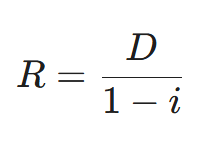
The third step is applying the revenue recomposition formula. Unlike a simple sum, the correct calculation uses division by the complement of the rate. If the total cost of expenses is D and the expected default rate is i, the total amount to be apportioned R is calculated using the formula:
The maths of recomposition: formula and practical examples
To illustrate the importance of using the correct formula, consider a condominium with fixed monthly expenses of R$30,000.00 and a consolidated historical default rate of 10%. If the property manager simply added 10% to the expense amount (R$3,000.00), they would set a total levy of R$33,000.00. However, if the 10% default rate is confirmed, the condominium will only collect 90% of that amount, i.e. R$29,700.00, generating a shortfall of R$300.00 in the very first month.
Using the suggested technical formula, the calculation would be: R$30,000.00 divided by (1 - 0.10), which results in R$33,333.33. In this scenario, even if 10% of residents fail to pay, the final amount collected will be exactly R$30,000.00, covering all obligations without harming the cash flow. This difference, though it may seem subtle over a single month, over the course of a 12-month financial year, represents the difference between a financially healthy condominium and an indebted one.
Applying the default margin should be monitored monthly. If actual default is lower than projected, the surplus collected can be allocated to the reserve fund or used to offset future expenses, strengthening the condominium's financial security. It is essential that the property manager keep a detailed spreadsheet comparing "Forecast" versus "Actual" to adjust the margin as residents' payment behaviour changes.
Gross versus net default: refining the cash flow
A crucial distinction the property manager must make in their financial reports is between gross default and net default. Gross default represents the total value of fees that were not paid in the month they were due, relative to total expected revenue. This is the indicator that measures the immediate "hole" in cash flow and serves as the basis for calculating the safety margin.
On the other hand, net default takes the gross default figure and subtracts credit recoveries from previous periods. For example, if in a given month the condominium failed to receive R$5,000.00 (gross), but recovered R$4,000.00 in old debts through legal settlements, the actual net default was only R$1,000.00.
Understanding this difference prevents the property manager from making hasty decisions. A condominium with high gross default but an efficient and consistent credit recovery process can work with a slightly lower default margin in the monthly levy, since it knows the cash flow will be replenished by retroactive receipts. However, prudence dictates that the ordinary budget should never depend on the uncertainty of legal collections to pay basic bills.
Items needed for a reliable calculation basis
Before applying the default margin, the property manager needs to ensure that the total amount of expenses (the calculation basis) is as accurate as possible. The annual budget plan must list all ordinary expenses, which are those that are recurring and essential to the condominium's operation. Ignoring components of operating costs will invalidate any safety margin established.
The essential items include payroll and social security contributions for in-house staff (or the outsourced company's contract), utility bills such as water,, electricity and gas for common areas, and preventive maintenance contracts for lifts, gates, swimming pools and security systems. In addition, municipal, state and federal taxes levied on the condominium's operations must be included.
Efficient planning also takes into account extraordinary expenses already approved at the general meeting, such as specific refurbishments or equipment purchases. The property manager should organise this information into clear categories, making it easier for the fiscal council and residents to review. Transparency in listing these items is what allows the final condominium fee amount to be justified.
Hidden costs and frequently forgotten expenses
Many managers face financial difficulties not due to poor control of default, but because they forget to provision for costs that don't occur every month. The most common mistake is failing to spread the payment of the 13th salary and the constitutional holiday bonus for staff throughout the year. Without this monthly reserve of 1/12, the condominium suffers a disproportionate impact on cash flow in November and December, precisely when default tends to rise.
Another frequently overlooked item is the annual adjustment of service contracts. The property manager often uses the current value of the security or management company's contract in the budget forecast for the following year, forgetting that these contracts have adjustment triggers tied to indices such as IPCA or IGP-M. When the adjustment takes place mid-year, the amount collected becomes insufficient, creating an unforeseen shortfall.
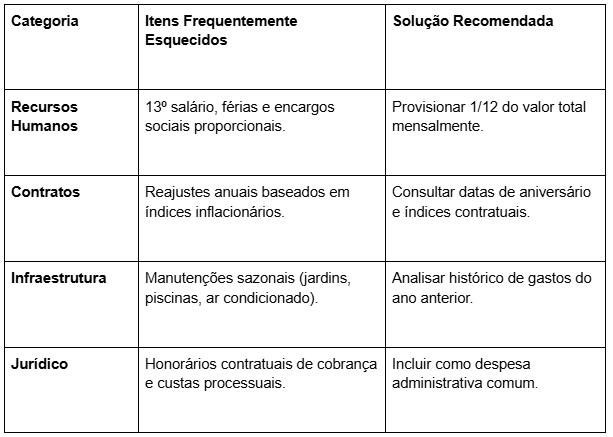
It is also common to forget to build up a reserve fund for emergency expenses, which should generally amount to 5% or 10% of monthly revenue. When the condominium does not have this fund, or misuses it to cover ordinary default, it becomes vulnerable to any structural mishap, which forces the calling of general meetings for extra levies, generating insecurity and dissatisfaction within the community.
Legal implications and the STJ's new interpretation
The property manager should keep abreast of changes in case law that affect debt recovery and the calculation of amounts owed. The Civil Code, in Article 1,336, paragraph 1, establishes that a defaulting unit owner is subject to the late-payment interest agreed in the condominium bylaws or, where not specified, to 1% per month, plus a fine of up to 2% on the amount owed. It is essential that these parameters be followed rigorously to avoid the collections being deemed void.
Recently, the Superior Court of Justice (STJ) issued a ruling with major implications for financial management: condominiums may not include contractual legal fees in the calculation of enforcement proceedings for overdue condominium fees, even where the bylaws provide for this. The Court's understanding is that these fees are a private matter between the condominium and its lawyer, and cannot automatically be passed on to the debtor as part of the condominium debt.
This ruling means that the cost of hiring lawyers to carry out collections must be borne by the condominium's cash flow as an ordinary administrative expense. For the property manager, this means that the collection structure must be factored into the annual budget plan, since the amount recovered from defaulters will not include reimbursement of the legal fees paid by the condominium to pursue them. Ignoring this legal reality can create a budget shortfall, since the condominium will spend money on legal services that will not be fully recouped from the debtor.
Sustainability and savings: the NewSun Energy Group solution

One of the smartest ways to manage default is by tackling the condominium's cost base, reducing fixed expenses to ease the pressure on the monthly levy. NewSun Energy Group's clean energy subscription emerges as a strategic ally in this process. This model allows the condominium to use solar energy credits generated at remote power plants, which stabilises the common-area electricity bill without the need for complex works, rooftop panel installation or upfront investment by the condominium.
The main financial advantage for the condominium is protection against the yellow and red tariff flags. During periods of energy crisis, when traditional tariffs rise significantly, the NewSun subscription ties the cost of energy to the green flag, guaranteeing budget predictability and progressive, sustainable savings. This stability makes it easier to calculate the default margin, since it removes a variable of uncertainty (fluctuations in the electricity bill) that tends to unbalance monthly projections.
Beyond the financial benefits, NewSun Energy Group stands out for its genuinely human and personalised service. Far from the bureaucracy of large utility companies, the property manager is treated as a strategic partner in the development's energy transition. To ensure complete transparency in management, the company offers an exclusive platform, NewSun Energy Club. Through it, the management team can track energy consumption, applied credits and total savings generated in real time, making it easier to report back to residents.
Find out more about our Solutions for Condominiums .
Strategies for getting the margin approved at the general meeting
Presenting the need for a default margin at the assembleia is a politically sensitive moment for the property manager. Paying residents may feel aggrieved on realising that the levy includes a margin to cover those who don't pay. To overcome this resistance, the property manager should base their argument on concrete data and on protecting the collective asset.
Using visual reports that compare the cost of maintaining a safety margin against the cost of resorting to an overdraft or incurring late fees on utility bills is essential. It is necessary to show that a lack of margin can lead to the interruption of basic services, such as cleaning and security, or to the postponement of structural maintenance which, if not carried out preventively, will cost much more in the future.
During the meeting, the property manager should clarify that the margin is not a "pardon" for the debtor, but a cash-flow mechanism. It should be emphasised that the condominium will continue to pursue defaulters with legal rigour and that, once recovered, these amounts will return to the common fund for improvements or to reduce future fees. When residents understand that the measure is designed to protect everyone rather than benefit defaulters, approval tends to happen much more smoothly.
The impact of default on property value
The property manager's role goes beyond paying bills; they are the custodian of the market value of residents' properties. Chronic default and the lack of an adequate safety margin quietly erode property value. When cash is tight, preventive maintenance is usually the first casualty. Poorly kept gardens, peeling façade paint and lifts with constant faults are clear signs of poor financial health that put off buyers and reduce rental values.
Beyond physical depreciation, default affects the condominium's "atmosphere". Conflicts at general meetings and the sense that some residents are being exploited to support others create a toxic environment, which also devalues the development. By contrast, condominiums with solid financial management and well-planned margins convey confidence to the property market. Adopting sustainable, energy-efficient solutions, such as a NewSun Energy Group subscription, reinforces this image of modernity and good management, directly contributing to the property being seen as a resilient, valued asset.
In conclusion, calculating the default margin in a technical and transparent way is one of the most critical responsibilities of the modern property manager. By mastering this tool, managers protect the condominium against economic uncertainty, ensure services run smoothly and preserve harmony among residents. The combination of an accurate calculation, rigorous monitoring of net default, and the pursuit of operational efficiencies, such as the savings generated by clean energy, forms the ideal tripod for successful condominium management in the 21st century.
You may also like
- Casos de Sucesso
 20/10/2026
 5m
5m - Dicas para Síndicos e PMES16/10/20265m
- Dicas para Síndicos e PMES13/10/20265m





Stop paying more for your energy bill
Find out in less than 1 minute how much you could save with clean energy every month — no works and no bureaucracy.
Join the energy revolution
Subscribe to our newsletter and receive exclusive content