

How to build the perfect budget for managing your condominium
How to build the perfect budget for managing your condominium
Dicas para Síndicos e PMES
 26/03/2026
 5 min
5 minManaging a condominium, whether by a resident manager or a professional property manager, is like running a “mini city”, requiring skills that go well beyond mediating interpersonal conflicts. At the heart of this machinery is financial health, which depends directly on the manager's ability to build the perfect budget. Predictability is not just an administrative convenience, but a pillar of legal certainty and asset appreciation. When a condominium operates under poor planning, it becomes vulnerable to unexpected capital calls, the notorious "extra fees", which are the main trigger for dissatisfaction and distrust among residents.
Building the perfect budget requires the property manager to look at the past in order to project the future. Analysing income and expenditure history over the last 12 to 24 months is the essential starting point for identifying consumption patterns, seasonal shifts and distortions that need to be corrected. Water and electricity costs, for example, vary significantly between summer and winter, while payroll is affected annually by collective bargaining agreements and provisions for charges. Mastering this data allows each service to be quoted based on real needs, rather than superficial estimates.
In addition to internal analysis, the macroeconomic scenario must be factored into planning. Indices such as the IPCA and IGP-M directly affect lift maintenance contracts, remote concierge services and condominium insurance. A property manager who neglects these indicators risks presenting an outdated budget forecast at the condominium assembly, which undermines the execution of preventive maintenance and can lead the building into a state of accelerated deterioration. Therefore, financial excellence begins with rigorous data collection and the methodical organisation of every quotation required to keep the community running.
What defines a perfect budget and why it is the pillar of transparency
A perfect budget is not the one with the lowest figures, but the one that reflects the building's technical and physical reality with the greatest possible accuracy. It must be structured so that any resident, even one with no accounting background, can understand where every cent collected comes from and where every real spent goes. Transparency is the antidote to conflict at the condominium assembly; when management presents clear data and justifications grounded in a rigorous tender process, resistance to necessary adjustments drops sharply.
To reach this level of excellence, the budget should be divided into three main blocks: ordinary expenses, extraordinary expenses and reserve funds. Ordinary expenses cover day-to-day operations (staff, utilities, preventive maintenance). Extraordinary expenses relate to improvements and refurbishments approved on a case-by-case basis. Reserve funds, meanwhile, act as the "safety cushion" for unforeseen events. A perfect budget integrates these categories coherently, ensuring the reserve fund is never used to pay utility bills, a common mistake that masks management failures.
Below is a breakdown of the fundamental structure that makes up the ideal financial plan:
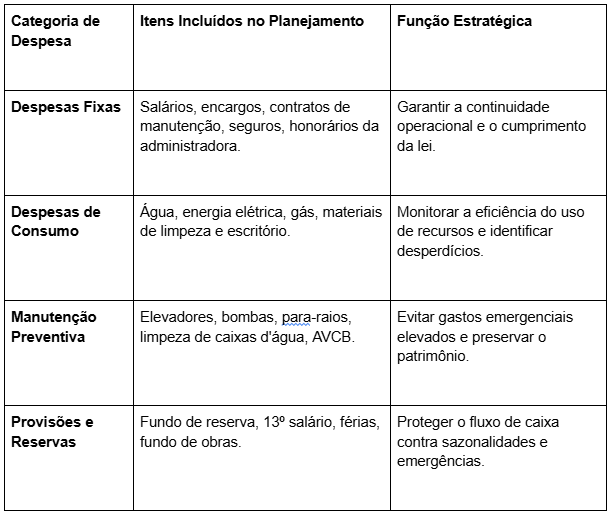
This organisation allows the property manager to arrive at the condominium assembly with a solid narrative. Rather than simply announcing a fee increase, they demonstrate, through each comparative quotation, that the condominium fee is a direct reflection of the cost of maintaining residents' quality of life and safety.
Professional tendering: turning the purchasing process into a management asset
The tendering process is possibly the most strategic task in condominium routine, and, at the same time, the most underrated. Many managers still operate reactively: something breaks, the property manager calls three familiar companies and picks the cheapest one. However, to achieve the perfect budget, quoting should be treated as a simplified tender process, where technical rigour comes before financial analysis. A professional tender process avoids what experts call "incomparable proposals", where supplier A offers a complete service and supplier B leaves out essential materials to appear cheaper.
The first step towards an excellent tender is drawing up the scope of work or specification document. The property manager must list exactly what is expected: material brands, execution deadlines, working hours and safety requirements (PPE). When all bidders respond to the same document, the property manager gains the ability to compare like with like, eliminating subjectivity that could spark pointless discussions at the condominium assembly. In addition, requesting a quotation must include a requirement for documents proving the company's good standing, such as an active company registration number, negative labour debt certificates and technical capacity for the service.
For works and services that affect the structure, the quotation must include delivery of the ART (Technical Responsibility Record) or RRT (Technical Responsibility Registration). The absence of these documents not only makes the proposal invalid under NBR 16,280, but also transfers civil and criminal liability for any accident or structural failure onto the property manager. Therefore, on the road to the perfect budget, rigour in selecting partners is what shields management from future liabilities.
The rule of three quotations: myth, truth or good management practice?
One of the most frequent questions faced by managers is whether it is mandatory to obtain three quotes for every purchase. Although national legislation, such as the Civil Code, does not set a fixed number of quotations, the "rule of three" has become established as a market standard and an excellent transparency practice. In many cases, the building's own by-laws or a previous decision at a condominium assembly may stipulate that, above a certain amount, collecting at least three proposals is mandatory to validate the expense.
However, for a perfect budget, the number of proposals should be viewed qualitatively. For highly complex services, such as façade refurbishment or lift modernisation, it is best to select four or five companies to ensure that, after technical and documentary screening, at least three solid proposals remain for final comparison. On the other hand, for routine, low-value purchases, the administrative effort of gathering multiple quotes can cost more in management time than the savings generated, unless an automated platform is used.
At the condominium assembly, the rule of three works as a persuasion tool. By presenting three distinct options, the property manager demonstrates that they have researched the market and hold no personal bias towards any supplier. More important than the magic number is the quality of the companies chosen for the quotation. There is little point in presenting ten quotes if they are all from companies with no references or with tax issues; that only generates noise and insecurity among residents. The perfect budget is built on the credibility of the data presented, not merely on the volume of paperwork gathered.
The quotation comparison map: the definitive guide for strategic decision-making
If the quotation is the input, the comparison map is the final product that allows the property manager to make the right decision. It is a comparative tool, usually structured in columns, that organises the collected information in a visual and logical way. Without a well-built comparison map, the property manager risks getting lost in a sea of PDF files, emails and printed proposals, which makes a holistic analysis of the benefits offered by each supplier impossible. For the perfect budget, this stage is crucial: it is in the map that competitive advantages and hidden risks become clear at a glance.
Building an efficient comparison map should follow a standardised logic. The rows of the table should list the scope items, while the columns represent each company. At the intersection of this data, you should include not just the nominal price, but also payment terms (upfront, instalments, grace period), delivery timeline, the validity of the proposal and the company's technical score. It is essential that the property manager include a "remarks" column, highlighting extended warranties, differentiated technical support or reservations raised by bidders during the site visit.
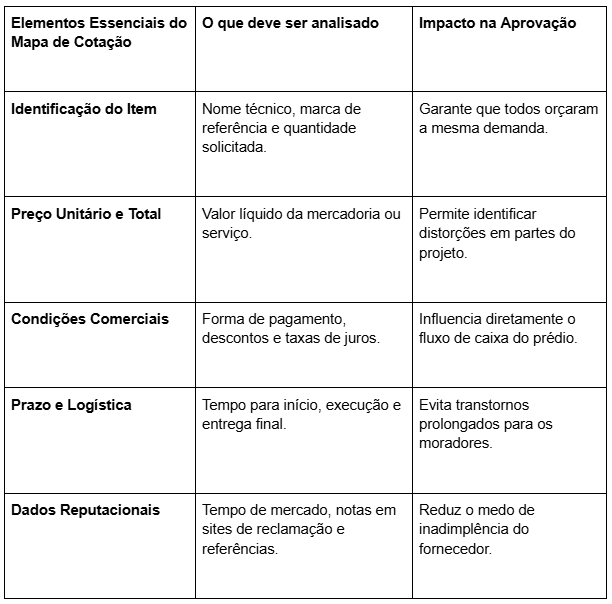
The comparison map is the document the property manager should bring, printed, to the condominium assembly. When a resident asks why company X wasn't chosen, the manager can point to the map: "Company X was 10% cheaper, but offered no warranty and required a 50% upfront payment with no proof of works insurance". This evidence-based transparency is what turns a tense meeting into a conscious rite of approval for the perfect budget.
Weighing the factors: price, supplier track record and technical quality
Choosing a supplier should not be a contest of who charges the least, but a search for the best overall value. In the context of the perfect budget, the property manager acts as a risk manager; every saving made at the expense of technical quality increases the likelihood of a much larger corrective cost in the short term. To balance these considerations, the manager must weight the selection criteria. In a quotation for cleaning water tanks, for example, work safety and post-service bacteriological testing carry far more weight than a small difference in the final price.
Assessing a supplier's track record requires active investigation. Sites like Reclame Aqui are good barometers, but they do not replace a review of court and tax records. A company with dozens of active labour lawsuits represents a real succession risk for the condominium, where residents could be called upon to pay debts owed to outsourced staff who were never their employees. In the perfect budget, legal certainty is non-negotiable; the supplier must be a partner that brings peace of mind, not a hidden liability.
Technical quality, in turn, should be assessed through direct references and certifications. During the quotation stage, the property manager should ask the supplier: "Which other condominiums of similar size have you worked with recently?" and, more importantly, contact those property managers directly. At the condominium assembly, sharing these positive testimonials from fellow managers is one of the most effective forms of persuasion. Residents feel reassured knowing the service has already been tested and approved in a similar setting to their own.
Mandatory items that no budget plan can afford to miss
There are items that, by force of law or technical standards, are mandatory and must appear in any budget, regardless of the wishes of the board or the assembly. Ignoring these obligations is a serious mistake that can lead to common areas being shut down or the building's insurance policy becoming void. When drawing up the annual quotation for financial planning, the property manager must ensure that the "schedule of obligations" is fully funded, preventing lack of resources from being used as an excuse for technical negligence.
The first item on the list of mandatory obligations is condominium insurance. Under Article 1,346 of the Civil Code, insurance against fire risk or total/partial destruction is compulsory and must be renewed annually. Another critical point is the Fire Department Inspection Certificate (AVCB). Its periodic renewal requires that fire-fighting systems (extinguishers, hydrants, signage) undergo rigorous maintenance and recharge quotations. A manager who removes these items from the budget to "lower the fee" is, in fact, committing an administrative offence that can result in heavy fines and personal civil liability.
In addition to these, the following stand out as mandatory items:
Cleaning of water tanks and potability testing (at least every six months).
Inspection and maintenance of lifts (monthly and legally compulsory in many municipalities).
Maintenance of the lightning protection system (SPDA) and issuance of the earth resistance measurement report.
Pest control and rodent control for common areas.
Provisions for labour charges and benefits for direct employees.
Ensuring these items are on the condominium assembly's agenda is the first step towards professional management. When the property manager separates what is "legally mandatory" from what is a "desired improvement", it makes decision-making easier for the community, who come to understand that certain quotations are not up for negotiation, but are requirements for the legal and safe existence of that community.
The cash-flow villains: items managers can forget but that make the budget coherent
Often, what pulls a plan away from reality and prevents the perfect budget is not the major maintenance work, but neglecting the "invisible costs". These are small items that don't appear in the initial quotation but crop up during execution of the service, creating friction at the condominium assembly and blowing out the cash flow. Experienced property managers know that a refurbishment proposal of R$50,000 can easily jump to R$60,000 if additional costs aren't planned for from the outset.
One of the most commonly forgotten items in works budgets is waste disposal. Renting skips and properly disposing of debris is required by environmental law and carries a fixed cost that is rarely included in the labour quotation from the builder or small contractor. Another villain is specialised post-works cleaning. Leaving cement residue or fine dust in common areas after a refurbishment leads to complaints and requires hiring a crew the property manager may have forgotten to budget for.
To make the budget more coherent and complete, the manager should include:
Tax withholdings: Condominiums are required to withhold taxes such as ISS, INSS and the PCC contribution (PIS, COFINS, CSLL) on services above certain amounts. If the property manager only looks at the net value of the quotation, they will be in for a surprise when they discover they need to pay out more to the public purse.
Protection of common areas: The cost of tarpaulins, hoarding and protective covers for lifts during the transport of materials must be included in the budget, protecting existing assets.
Cost of payment slips and bank fees: Small administrative charges for each payment slip issued to residents can add up to thousands of reais a year, an invisible cost that erodes the reserve fund.
Margin for technical adjustments: In plumbing or electrical works, it is prudent to allow a margin of 5% to 10% for unforeseen issues that only surface once walls are opened up.
Including these details at the planning stage shows residents that the property manager keeps a meticulous grip on operations. When these items are presented at the condominium assembly, they convey a sense of "zero-based management", where every expense is justified and nothing is left to chance for the following month.
Stability and savings: NewSun Energy Group's clean energy subscription

One of the heaviest and most unpredictable components in any condominium budget is the electricity bill for common areas. Lifts, pressurisation systems, garage lighting and pool heating consume energy 24 hours a day, exposing financial planning to fluctuations in tariff flags and annual adjustments authorised by ANEEL. It is in this scenario that NewSun Energy Group positions itself as a strategic partner for the property manager seeking the perfect budget, offering an innovative solution: a clean energy subscription.
Unlike traditional solar power, which requires an extremely high upfront investment in photovoltaic panels, roof works and ongoing maintenance, the NewSun subscription is 100% digital and hassle-free. Energy is generated at NewSun's own solar farms or biogas plants and fed into the local distributor's grid in the form of credits. For the condominium, the benefit is immediate: progressive savings, freeing up funds that can be used for other improvements or to reduce the condominium fee.
In addition to financial savings, the NewSun solution offers:
Bill stabilisation: The subscription shields the condominium against the volatility of tariff flags (yellow, red 1 and red 2), providing the spending predictability that underpins the perfect budget.
Genuinely human support: In a sector dominated by utility companies' self-service bots, NewSun offers personalised support, understanding the particularities of condominium management.
Real sustainability: The condominium starts using energy from renewable sources, boosting its ESG credentials and increasing property value in the eyes of residents and investors who prioritise environmental responsibility.
Including the NewSun subscription in the annual expenditure quotation is a decision that positions the property manager as a modern, forward-thinking manager. Rather than being at the mercy of the traditional energy system, they take control of one of the building's largest fixed costs, ensuring the condominium assembly hears good news about reduced ordinary expenses.
Discover our Solutions for Condominiums.
Transparency and persuasion: strategies for approval at the condominium assembly
The condominium assembly is the court where the property manager's work is put on trial. Many managers do excellent technical work and secure great prices on every quotation, but fail at the approval stage due to poor communication. To secure approval, the property manager should adopt a clear, transparent approach, turning abstract figures into tangible benefits for the community.
One foolproof strategy is advance notice. Sending the budget forecast and the comparison map to residents at least 7 to 10 days ahead allows them to review the data calmly. This reduces the sense of "ambush" that many residents feel at meetings where they're confronted with fee increases without prior warning. During the meeting, using visual aids such as organised slides, comparative "Forecast vs. Actual" charts and photos justifying the need for urgent maintenance helps bring the manager's argument to life.
When handling objections, the property manager should focus on the concept of asset appreciation. "We're not spending R$20,000 painting the garage; we're investing in R$50,000 worth of added value across each flat through upkeep". When the condominium assembly realises that the perfect budget is what protects the largest financial investment of their lives — their own home — resistance gives way to collaboration. Ethical persuasion, grounded in honest quotations and verifiable data, is the key to peaceful, effective management.
Impact of the Tax Reform: what to expect for 2026/2027 budgets
The financial landscape for condominiums is about to undergo one of the biggest changes in decades with the implementation of the Tax Reform. From 2026, Brazil will begin its transition to a dual Value Added Tax (VAT) model, made up of the CBS (federal) and the IBS (state and municipal). For the property manager aiming to keep the perfect budget, understanding these impacts is essential, as they will directly affect every quotation for outsourced services, such as concierge, cleaning and maintenance.
Currently, the cost of services for condominiums is taxed in a fragmented way. With unification, the rates applied to services could rise significantly, reaching between 18% and 26.5%. As condominiums are treated as end consumers and cannot claim tax credits, this increase will be passed on in full to budget spreadsheets. This means long-term contracts signed today should include economic-financial rebalancing clauses for 2026 and 2027, or risk suppliers defaulting or an immediate cash-flow blowout.
To prepare, the manager should:
Analyse suppliers' tax regime: Companies under the Simples Nacional scheme and micro-entrepreneurs (MEIs) may see a smaller impact on final prices compared with companies under the Lucro Real or Lucro Presumido regimes.
Factor adjustments into the annual forecast: The 2026 budget should already allow a safety margin for the start of the CBS and IBS test-rate rollout.
Communicate with the condominium assembly: Explaining in advance that future increases may stem from federal legislative changes takes the weight of "poor management" off the property manager's shoulders.
Being proactive on tax analysis is a high-level differentiator. A property manager who masters these topics arrives at the condominium assembly with ready answers, protecting the building's financial health against the looming tax inflation and ensuring the perfect budget continues.
Conclusion: the ongoing journey towards condominium management excellence
Achieving the perfect budget is not a one-off event, but an ongoing process of vigilance, transparency and openness to innovation. Today's property manager needs to move beyond the amateur approach of "choosing the lowest price" and embrace the complexity of data-driven, technically sound, fiduciary management. Every well-run quotation and every detailed comparison map are building blocks of a solid reputation before the condominium assembly.
To consolidate these practices, it is recommended that the manager maintain an open, proactive line of communication, anticipating questions and educating residents on the importance of investing in preserving the property. Ultimately, the perfect budget reflects a property manager who understands that their role is to protect the present and plan the future for dozens of families, turning the condominium into a model of efficiency and sustainability for society as a whole.
You may also like
- Casos de Sucesso
 20/10/2026
 5m
5m - Dicas para Síndicos e PMES16/10/20265m
- Dicas para Síndicos e PMES13/10/20265m





Stop paying more for your energy bill
Find out in less than 1 minute how much you could save with clean energy every month — no works and no bureaucracy.
Join the energy revolution
Subscribe to our newsletter and receive exclusive content