

From DIRF to EFD-Reinf and eSocial: what building managers need to know
From DIRF to EFD-Reinf and eSocial: what building managers need to know
Dicas para Síndicos e PMES
 12/03/2026
 5 min
5 minBrazil's tax ecosystem is undergoing a digital transformation that profoundly alters the basis of reporting for companies and equivalent entities, such as condominiums. The abolition of the Withholding Income Tax Return (DIRF), a pillar of federal oversight since the 1990s, and its full replacement by the modules of the Public Digital Bookkeeping System (SPED), specifically eSocial and the Digital Tax Bookkeeping of Withholdings and Other Tax Information (EFD-Reinf), marks the end of an era of annual processing and the start of real-time tax monitoring.
For the building manager, this transition requires not just a technical update but a shift in how documents and cash flow are managed, since the Federal Revenue Service now captures and cross-checks data continuously, eliminating the twelve-month window that previously allowed adjustments and corrections before the annual return was filed.
DIRF operated as a consolidation return. Throughout the calendar year, paying entities made withholdings and only at the start of the following year reported to the tax authority who the beneficiary was, the gross amount and how much had been withheld. This model, though functional for decades, became obsolete in the face of the government's cloud processing capacity.
With the introduction of eSocial and EFD-Reinf, the tax authority began requiring the same information to be submitted monthly. 2025 is the watershed year: taxable events occurring from 1 January 2025 will no longer be declared in the old DIRF Return Generator Program (PGD) in 2026. Instead, the obligation will be considered fulfilled through the monthly submissions made throughout 2025.
This systemic change aims to eliminate duplicate information. Since 2018, companies had already been sending payroll data via eSocial, only to repeat that same data in the annual DIRF. Full integration resolves this redundancy but raises the bar for data accuracy. An error made on January's payroll or February's invoice now has an immediate impact on the taxpayer's compliance checks and the condominium's tax standing.
Fundamentals and Structure of the Replacement: The Two Pillars
The Federal Revenue Service structured the replacement of DIRF around two distinct technological branches, categorising the nature of the payment to determine which platform should receive the information. For condominiums, which deal with both their own employees and a wide range of service providers, understanding this division is the first step to avoiding fines for omission.
The eSocial Pillar: Employment Income
The eSocial takes full responsibility for income directly or indirectly related to employment. In the condominium context, this branch manages the complex network of payments involving payroll and labour charges. The system not only receives the gross amounts but also validates the deductions permitted by law, such as official social security contributions and dependants.
The most relevant eSocial events for the replacement of DIRF are:
S-1200 (Worker Remuneration): Reports the gross amount owed to the worker.
S-1210 (Payment of Employment Income): This is the leading event in the replacement of DIRF, as it reports the actual payment date and net amounts, as well as detailing income tax withholdings.
S-2501 (Tax Information Arising from Labour Proceedings): Used to report income tax withheld in labour court settlements or rulings.
The EFD-Reinf Pillar: Tax Withholdings and Payments Without an Employment Link
The EFD-Reinf, in turn, focuses on what the Federal Revenue Service calls "Other Withholdings". This module is the destination for all condominium financial transactions that do not go through payroll. With the introduction of the R-4000 series, Reinf began capturing federal withholdings (income tax, PIS, COFINS and CSLL) on services taken from companies and various payments to individuals.
For condominiums, EFD-Reinf is the channel for reporting:
Invoices from maintenance, security and cleaning companies with tax withholdings.
Rent payments to individual property owners.
Commissions and brokerage fees paid to management companies (whether or not subject to self-withholding).
Distribution of profits, where the condominium has investment income that allows this practice.
The R-4000 Series: The Technical Core of the Transition for Condominiums

The R-4000 series is, technically, the set of events that buried DIRF. While the R-2000 series was already familiar to building managers for dealing with social security withholding (INSS) on service providers' invoices, the R-4000 series brought a new layer of detail for the remaining federal taxes.
Event R-4010: Control Over Rent Payments and Professional Building Managers
The R-4010 event applies to payments made by the condominium to individual beneficiaries with no employment relationship. A crucial point of attention for the building manager is the remuneration of professional building managers acting via their individual taxpayer number (CPF), or the exemption from condominium fees granted to a resident building manager. The Federal Revenue Service considers this fee exemption to be taxable income. If the value of this exemption exceeds the ceiling of the progressive income tax table, the condominium must withhold the tax and report it monthly in R-4010.
Another frequent application is the payment of rent. Condominiums that rent houses or flats for staff, or that let out communal areas to third parties, must use this event to detail the amounts credited to the owners. Unlike eSocial, here the information is submitted in the month of payment (cash basis).
Event R-4020: Invoices from Corporate Service Providers
This is the highest-volume record in active condominiums. R-4020 captures withholdings made on payments to other companies. The building manager should be aware that income tax withholding follows the "credit" taxable event (generally the invoice issue or acceptance date), while the CSRF contributions (PIS, COFINS, CSLL) follow the "payment" taxable event.
This dichotomy requires perfect alignment with the finance department:
If an invoice is issued on 28 August but the condominium pays it on 5 September, the income tax withholding must be reported in August's Reinf filing, and the social contributions in September's Reinf filing.
Instalment invoices generate multiple CSRF records, linked to each due date.
Event R-4040: The Danger of Unidentified Beneficiaries
This event is a punitive tool used by the tax authority. It must be used when the condominium makes payments without being able (or willing) to identify who received the funds. In condominiums, this can occur in cases of undeclared cash payments, bonuses paid without a receipt, or emergency expenses paid in cash to informal providers who do not issue documents.
The tax cost of using R-4040 is prohibitive. Income tax is set at 35% on the grossed-up amount (gross-up formula), resulting in an additional outlay of more than 50% of the net value of the expense. A building manager who allows this type of operation exposes the condominium to a severe financial loss and an immediate risk of audit, given that this tax falls due daily.
Event R-4080: Withholding at Receipt and Self-withholding
This event covers situations where the service-providing company itself collects the tax, such as credit card administrators and advertising agencies. In the past, the condominium had to declare these commissions in DIRF. Now, under Normative Instruction RFB 2163/2023, the client (the condominium) has been exempted from the reporting obligation when the provider carries out self-withholding and submits R-4080, simplifying the routine for the condominium's management company.
Tax Calendar and Deadlines for 2026: The Rhythm of Management
Compliance in 2026 does not tolerate delays. Condominiums, placed in Group 3, operate under a strict monthly calendar. Failure to complete any one of the steps blocks the process for generating payment slips and triggers automatic fines.
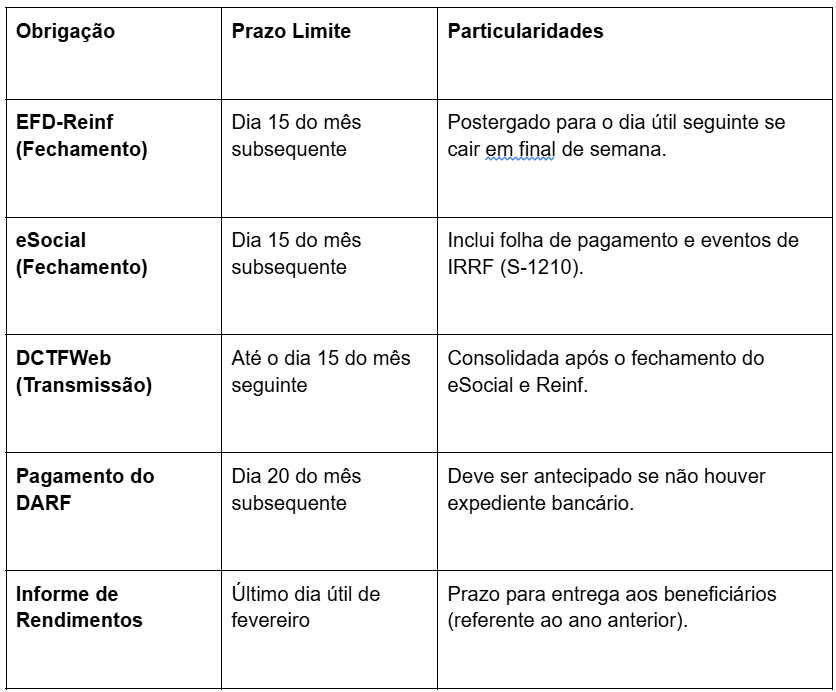
A critical detail for condominiums is the 2026 deadline for the Income Statement for the 2025 calendar year: the deadline is 27 February 2026. Unlike DIRF, where the government's system generated the statement, it is now the responsibility of the condominium's payroll or accounting system to extract this data from the monthly submissions made throughout 2025.
The Income Statement in the Post-DIRF Era: Responsibilities and Risks
Many managers mistakenly believed that the end of DIRF would mean the end of the Income Statement. The reality is the opposite: the legal obligation, based on Normative Instruction RFB No. 2,060/2021, remains fully in force. What changed radically was the origin of the data and the mechanics of issuing it.
Origin of the Information and Verification
In 2026, condominiums must issue statements using the data consolidated in eSocial and EFD-Reinf. To ensure that the document handed to the doorman or a corporate service provider contains no errors, the Federal Revenue Service introduced the DIRF Extractor (Consolidated Income Tax Withholding Statement) on the e-CAC portal.
The Extractor works as a digital mirror. It gathers everything submitted monthly via the S-1210 events (eSocial) and the R-4000 series (Reinf) and presents the balance held by the tax authority in its database.
Discrepancy Panel: The Extractor flags discrepancies between the systems. If the amount processed by the government does not match the condominium's payroll system, the Extractor will indicate the inconsistency.
Data Correction: If a discrepancy is found, the building manager does not correct the information in the Extractor. It is necessary to reopen the payroll for the corresponding month or amend the Reinf event and resubmit it.
Penalties for Errors in the Income Statement
Issuing an Income Statement with data that does not match eSocial/Reinf is the shortest route to landing employees and service providers in a tax audit, which can lead to non-material damages claims against the condominium. In addition, the administrative penalties are severe:
R$41.43 per statement provided late or with errors.
A fine of 300% on the amount omitted in cases of false information that results in an improper reduction in tax owed.
Integration with DCTFWeb: The Era of the Single Numbered DARF

The consolidation of EFD-Reinf and eSocial culminates in DCTFWeb (Federal Tax Debts and Credits Return). This system acts as the central point for the condominium's debt declaration.
The payment process has changed dramatically:
Submission of Bookkeeping Records: The condominium sends payroll data to eSocial and service payments to Reinf.
Automatic Feed: The data flows into DCTFWeb in real time.
Generation of the Numbered DARF: The system generates a single payment slip with a numbered barcode, covering both social security (INSS) and federal withholdings (income tax and CSRF).
This automation removes the need to issue several manual slips, but it brings a risk: if the management company forgets to submit the Reinf filing, the DARF generated by DCTFWeb will include only the eSocial amounts. The condominium will believe it is up to date, but will have omitted the withholdings from corporate service providers, generating tax liabilities and Selic interest charges.
Fines and the Cost of Non-Compliance in 2026
Digital enforcement is relentless and automatic. Late submission of EFD-Reinf or DCTFWeb triggers immediate notifications in the e-CAC environment.
The penalties in force in 2026 are structured as follows:
Late EFD-Reinf Submission: 2% per month on the amount of taxes reported, capped at 20% of the total owed.
Incorrect Information in Reinf: R$20.00 for each batch of 10 data items omitted or containing errors.
MAED (Fine for Late Filing) for DCTFWeb: A minimum of R$200.00 for condominiums with no activity and R$500.00 for condominiums with activity, which can increase in line with the amount owed.
Selic Interest: Charged on unpaid debts, at rates that can exceed 1% per month.
Beyond the financial impact, non-compliance blocks the Certificate of Tax Clearance (CND). Without a CND, the condominium is unable to secure bank financing for structural refurbishments, faces difficulties renewing compulsory insurance policies, and the building manager may face civil sanctions for administrative negligence.
Practical Organisation Guide for the Building Manager
Maintaining compliance requires the building manager to take an active role in data management, acting as the link between building operations and the accounting/management company.
Managing the Digital Certificate
The Digital Certificate is the key to accessing SPED. Without it, no return can be submitted.
Choice of Format: The A1 model (digital file) is recommended, as it can be installed on the management company's servers, streamlining the submission process. The A3 model (physical token) requires in-person handling, which increases the risk of missed deadlines.
Validity Control: The building manager should include certificate renewal in the annual plan of objectives. Certificates that expire on the 15th are the leading cause of delays in Reinf filings.
Screening Tax Documents
The building manager and support team (caretaker or building supervisor) need to be trained to sort the invoices that generate tax obligations.
Advance-Notice Workflow: Although the deadline is the 15th, the condominium should set an internal "closing day" (e.g. the 2nd of every month) for sending all documentation to the management company.
Corporate Invoices with Withholding: Identify concierge, cleaning, security, lift maintenance, pest control and gardening services.
RPA Payments: Self-employed payment receipts for small repairs must be formalised immediately.
Auditing and Transparency
The building manager should require monthly reports from the management company proving compliance:
eSocial and EFD-Reinf submission receipts.
DIRF Extractor statement compared against the monthly trial balance.
Proof of payment of the Numbered DARF.
In this environment of tight control, the condominium's financial health becomes vital. Strategies that reduce fixed costs give the building manager greater budgetary room to invest in management and compliance systems.
A notable example is the adoption of clean energy by subscription, which can stabilise the electricity bill for communal areas without the need to invest in works. This direct saving not only eases cash flow for the centralised tax payment on the 20th, but also strengthens management transparency towards residents through digital consumption-monitoring platforms, such as Energy Club.
Find out more about Solutions for Condominiums from NewSun Energy Group.
Implications of Tax Reform and the Future of Compliance

The end of DIRF is just one step in a broader journey of tax simplification and centralisation. The trend is for all national and municipal taxes to migrate to platforms integrated with SPED.
With the Tax Reform approved and under regulation, new taxes such as the Tax on Goods and Services (IBS) and the Contribution on Goods and Services (CBS) are expected, in future, to be reported through mechanisms similar to those of EFD-Reinf and eSocial. The condominium that has already mastered the monthly routine of digital bookkeeping will be light-years ahead in adapting to the new taxes.
Strategic Conclusions for Condominium Management
The transition from DIRF to EFD-Reinf and eSocial represents the biggest change in condominium bureaucracy of the past decade. To navigate 2026 safely, the building manager must focus on three pillars: digitalisation, anticipation and verification.
The documentation generated monthly stops being a "necessary evil" and becomes the condominium's legal shield. Systematic use of the DIRF e-CAC Extractor, rigorous control of the Digital Certificate's validity, and full alignment with the management company are the only ways to prevent the condominium from becoming a debtor to the federal tax authority.
Ultimately, the end of the annual return and the arrival of monthly events reward professional management. The building manager who organises their taxable events and keeps cash flow predictable — including through financial-efficiency technologies such as energy by subscription — secures not just tax compliance, but asset value and social peace within the development. Digital compliance is not an option; it is the new standard of excellence in condominium management in Brazil.
You may also like
- Casos de Sucesso
 20/10/2026
 5m
5m - Dicas para Síndicos e PMES16/10/20265m
- Dicas para Síndicos e PMES13/10/20265m




Stop paying more for your energy bill
Find out in less than 1 minute how much you could save with clean energy every month — no works and no bureaucracy.
Join the energy revolution
Subscribe to our newsletter and receive exclusive content