

Everything About the Condominium Reserve Fund: Rules, Uses and Mistakes
Everything About the Condominium Reserve Fund: Rules, Uses and Mistakes
Dicas para Síndicos e PMES
 22/05/2026
 5 min
5 minFinancial management of a condominium requires a constant balance between preventive maintenance of the building's structures, mitigation of emergency risks and control of ordinary cash flow. Within this ecosystem, the reserve fund plays the role of the main safeguard against financial destabilisation caused by accidents or large, unforeseeable expenses. Far from being merely a passive savings pot, this resource represents a strategic governance and asset-protection mechanism for owners, residents and managers.
Understanding how the reserve fund works, how it is structured for accounting purposes and the legal rules that govern it is essential to avoid internal conflicts, exhausting extra charges and problems with legal liability. This article details the legal, operational and practical aspects that govern the condominium reserve fund, pointing out the most common mistakes in its management, the strategies for keeping it capitalised even under the impact of non-payment, and how intelligent use of the budget — combined with modern subscription-based energy solutions — can shield the condominium's cash flow.
What the Condominium Reserve Fund Is and What It Is For
The condominium reserve fund is a stock of capital accumulated monthly through contributions from unit owners, with the aim of guaranteeing financial support for emergency, unavoidable expenses not covered in the building's annual ordinary budget forecast. According to the specialised doctrine of Rosely Benevides de Oliveira Schwartz, the reserve fund constitutes the portion collected to cover urgent, unforeseen expenses of proven necessity. Complementing this understanding, the jurist José Mário Cavalcanti defines the fund as a collection separate from the ordinary service charges, designed specifically to cushion the impact of unforeseen situations.
The legal basis for the reserve fund is set out in Law No. 4,591/1964 (the Condominium Law), which in Article 9, § 3, item "j", expressly provides that the condominium's by-laws must determine the form of contribution for setting up this fund. Although the 2002 Civil Code does not regulate the accounting details or use of the reserve fund, it establishes, in Article 1,334, item I, and Article 1,336, item I, the obligation of unit owners to contribute towards the condominium's common expenses, delegating to the internal by-laws and assemblies the authority to set the operational rules.
In the context of rented properties, the division of responsibility for paying into the reserve fund is strictly defined by the Tenancy Law (Law No. 8,245/1991). Under Article 22, sole paragraph, item "g", the initial setting-up of the reserve fund is considered an extraordinary expense, and it is the exclusive obligation of the property owner (landlord) to bear this charge. On the other hand, the tenant (leaseholder) is only responsible for topping up or replenishing the reserve fund if it is used to cover routine ordinary maintenance and upkeep expenses, and only up to the exact amount spent for that specific purpose.
Financial Structuring and Calculating the Ideal Percentage

Proper structuring of the reserve fund must follow strict accounting and asset-control criteria to ensure management transparency. The main pillar of sound administration is account segregation: the reserve fund must be held in a specific bank account, separate from the current account through which the condominium's ordinary cash flow passes. This separation prevents the fund from being silently drained for routine payments and ensures residents can clearly verify how contributions build up in the monthly financial statements.
In addition, managers must distinguish the reserve fund from the works fund. The reserve fund is intended for unforeseen events and emergencies requiring immediate action, whereas the works fund is a planned savings instrument for improvements, structural refurbishments and aesthetic upgrades previously approved at an assembly. Mixing these purposes distorts financial predictability and undermines the liquidity needed to respond to accidents.
Setting the amounts to be collected involves both the monthly contribution rate charged to residents and the safe accumulation ceiling for the condominium. The table below sets out the guidelines recommended by good property governance practice:
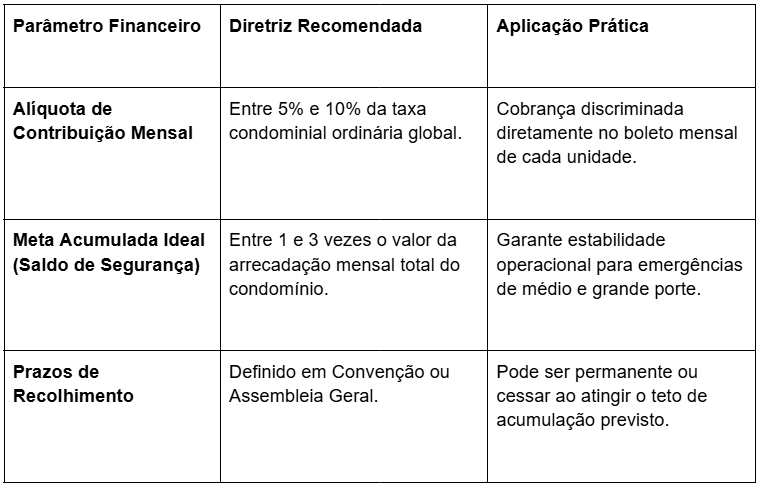
To calculate the individual contribution and the fund's consolidated target, the following mathematical formulas are used:
Individual Monthly Contribution = Unit's Ordinary Service Charge × Fund Percentage (5% to 10%)
Reserve Fund Target = Total Monthly Collection × k (where 1 ≤ k ≤ 3)
As a practical example, if a condominium has an ordinary expense budget of R$40,000.00 per month and sets a contribution percentage for the reserve fund at 8%, the monthly amount directed to the fund will be R$3,200.00, allocated proportionally among the owners according to their ownership shares. This condominium's ideal accumulated balance should range between R$40,000.00 and R$120,000.00 to ensure safe cover against structural accidents.
Practical Use of the Funds: What to Do and What Not to Do
Mobilisation of reserve fund resources must be strictly guided by the nature of the expense presented. Using the fund to finance the condominium's current running costs is a serious administrative mistake, only acceptable in extreme cash-collapse conditions and subject to immediate resolution and a repayment plan.
Take a look at some of the permitted uses (Emergencies and Extraordinary Expenses):
Urgent repair of burst water pipes causing structural leaks.
Immediate replacement of burnt-out water pumps that interrupt the building's water supply.
Emergency corrective maintenance of stalled lifts.
Repair of suddenly damaged automatic gate motors.
Emergency repair of building roofs after weather-related incidents (roof damage).
See also examples of prohibited or restricted uses (Ordinary / Non-essential Expenses):
Payment of staff salaries, current employment charges or holiday pay for in-house staff.
Settlement of monthly consumption bills such as electricity supply and communal water.
Carrying out aesthetic improvements and non-essential refurbishments with no structural urgency.
Funding seasonal celebrations, decorations or social events for the condominium.
Systematically covering budget shortfalls caused by poor annual planning.
Should an emergency withdrawal for ordinary expenses occur under assembly authorisation, the administration takes on the legal commitment to record the transaction separately in the financial statements and begin the agreed replenishment plan.
Governance and Assembly Rules for Mobilising the Fund
Use of the reserve fund's resources must not take place through a unilateral act by the property manager, except in cases of extreme urgency where delaying the expense could cause irreparable damage to the building's structure or to residents' safety. Even in these major emergency situations, the manager is required by the Civil Code to immediately inform the fiscal council and promptly convene an extraordinary general assembly to provide explanations, present budgets and approve the strategy for replenishing the fund.
When use of the fund is intended for expenses that are not of an immediately urgent nature, mobilising the balance requires a resolution and prior approval at an assembly. The quorum rules for resolutions relating to the reserve fund vary according to the purpose of the vote and what the condominium's by-laws dictate. The table below shows the quorum structure set out in current legislation and best legal practice:
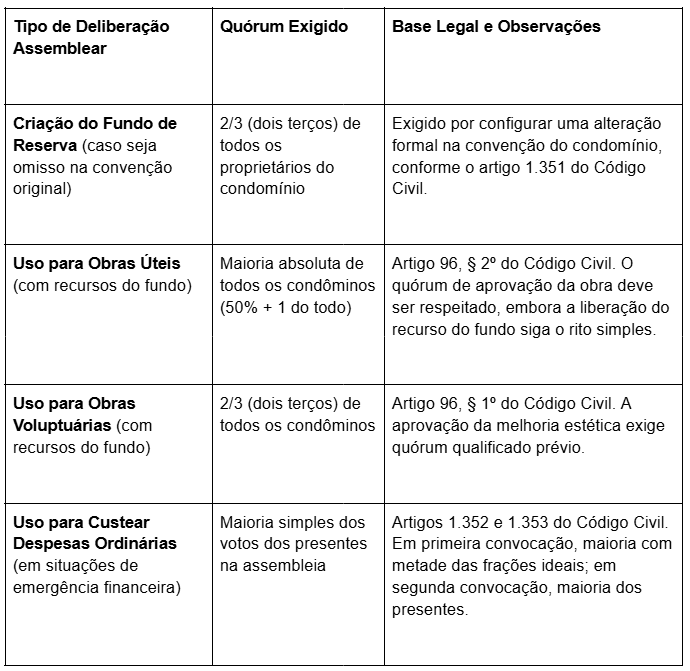
If the condominium's by-laws contain express clauses limiting the use of the reserve fund or setting stricter quorums than the general rule of the Civil Code, the provisions of the by-laws must be strictly observed, since they function as the development's sovereign internal law.
Critical Mistakes in Reserve Fund Management
Mistakes in managing the reserve fund are a vulnerability factor that can drag condominiums into financial collapse, generating internal political friction and legal action. A lack of technical attention from property managers, sometimes driven by the urgency of balancing the monthly cash flow, results in harmful administrative habits that erode the condominium's protections.
Recurrent Use for Ordinary Expenses and the Cash-Flow Habit
The most common mistake is using the reserve fund to cover routine costs of maintenance and current expenses, such as staff payroll or public utility bills. This systematic misuse masks serious flaws in the cost estimates contained in the condominium's annual budget forecast. By turning to the fund to balance the monthly cash flow, the manager creates a silent and dangerous administrative habit. When a serious unforeseen event arises — such as a lift breakdown or a severe structural leak — the condominium discovers it has no safety balance, being forced to convene urgent assemblies and impose unexpected extra charges, which generates collective dissatisfaction.
Mobilising the Balance Without Assembly Authorisation
Many property managers act on the mistaken assumption that the reserve fund is a resource the management can freely draw on for any project deemed beneficial. However, except in situations of extreme, factual emergency, any withdrawal made without due assembly authorisation compromises the legitimacy of the accounts and the manager's mandate. This conduct breaches the duty of transparency and can result in civil litigation and the formal rejection of the annual accounts by the fiscal council and by residents gathered at the ordinary general assembly.
Negligence in Replenishing Withdrawn Resources
Even when withdrawal of reserve fund amounts has been duly approved at an assembly to respond to a moment of financial fragility, the absence of a formal plan to replenish the balance is a serious failing. Many condominiums withdraw significant amounts and fail to plan the gradual return of that capital, leaving the development unprotected for future periods. Replenishment is a mandatory administrative duty and must be expressly recorded in the minutes, detailing the temporary extra rate or the instalment plan for repaying the amount used.
Lack of Accounting Segregation and Regular Monitoring
Combining all of the condominium's income into a single ordinary cash-flow account, with no separate statements for the reserve fund and other specific funds, makes genuine financial control impossible. The absence of regular monthly monitoring means management only becomes aware that resources are unavailable at the very moment a building emergency occurs. The modern property manager must monitor the balance using integrated tools that ensure accurate tracking of all movements.
Criminal Implications: Misappropriation and Fraudulent Management
Deliberately diverting reserve fund resources for the manager's personal benefit or for third parties, without legal or assembly backing, exposes the manager to strict penalties set out in the Brazilian Criminal Code. Intentionally diverting condominium money constitutes the crime of Misappropriation, defined in Article 168 of the Criminal Code, which carries a penalty of one to four years' imprisonment plus a fine.
In addition, if the manager, holding administrative powers, diverts funds by means of fraud, manipulation of financial statements or concealment of actual balances in order to obtain unlawful advantages, they may incur the penalties for Fraudulent Management, which include two to six years' imprisonment, in addition to civil liability for losses and damages arising from the breach of fiduciary duty.
How to Build and Replenish the Reserve Fund Amid Non-Payment
Non-payment is one of the main factors destabilising a condominium's finances, as it creates an immediate collection shortfall that jeopardises payment of basic bills and capitalisation of the reserve fund. Since the condominium depends strictly on apportioning expenses among residents, non-payment by some units places extra strain on paying residents and prevents the safety plan from being fulfilled.
To build and replenish the reserve fund in scenarios of high non-payment, the property manager must adopt technical strategies that combine legal rigour with budgetary intelligence.
Provision for Non-Payment in the Budget Forecast
When drawing up the condominium's annual budget forecast, the administration must not make the mistake of projecting income on the assumption of full collection (100% of units paying) if the historical record shows delays. If the building's historical non-payment rate is around 15%, the condominium must include a technical provision margin for non-payment corresponding to that reality in the ordinary budget forecast approved at the ordinary general assembly.
This margin is designed to keep the operating cash flow balanced, preventing the administration from having to withdraw amounts from the reserve fund to pay routine, essential expenses due to the temporary shortfall caused by defaulting residents.
Allocating Income Recovered from Settlements and Legal Action
When the condominium succeeds in recovering overdue amounts — through out-of-court collection, instalment settlements or court proceedings to recover unpaid charges — the amounts received should not simply be deposited into the ordinary account without apportionment criteria. In line with accounting governance guidelines, the property manager is obliged to carry out an analytical replenishment of the cost centre affected during the period in which the non-payment occurred.
The calculation for segregating and replenishing the recovered income must follow the exact proportion set out in the by-laws or in the assembly resolutions from the period to which the debts relate. The mathematical formula applied to correctly allocate the recovered amounts is expressed as:
Amount Allocated to Reserve Fund = Total Amount Recovered × Fund Contribution Rate
Amount Allocated to Ordinary Cash = Total Amount Recovered - Amount Allocated to Reserve Fund
For example, suppose a condominium manages to recover R$32,000.00 in overdue charges relating to a period when the monthly rate set for the reserve fund was 10%. Of the amount recovered, the manager must transfer R$3,200.00 directly back to the reserve fund's specific bank account, restoring the balance that should have been contributed had the unit been up to date. The remaining R$28,800.00 will go to the condominium's ordinary cash account to offset the current expenses borne by the other residents at the time.
Credit Alternatives and Income Advances
If the condominium urgently needs to replenish the reserve fund balance due to an immediate structural emergency, or wishes to carry out essential works without imposing high, immediate extra charges on residents, the property manager can turn to condominium credit alternatives or contract income-guarantee providers. These solutions help stabilise the monthly cash flow, ensure strict compliance with planned expenses and enable large contributions to be paid in instalments, spreading the budgetary impact and protecting internal reserves from unexpected collapses.
Intelligent Budget Use and NewSun's Subscription Energy Innovation

Building a healthy reserve fund does not need to depend solely on raising monthly charges or levying extraordinary contributions from residents. Efficient condominium governance shows that the most sustainable way to generate cash for investments and safety reserves is a planned reduction in ordinary operating expenses. By optimising the building's fixed monthly costs, the administration generates a continuous, predictable financial surplus that can be channelled towards capitalising the reserve fund.
Among the fixed costs that most affect a condominium's ordinary budget is the electricity tariff associated with common areas (lighting for car parks and corridors, lift systems, pumps and gates). The volatility of tariff surcharge bands during dry periods considerably increases this expense, creating budgetary instability. It is precisely in this essential expense that the NewSun Energy Group subscription energy solution acts as a strategic tool for savings and sustainability for condominiums.
How Clean Subscription Energy Works
NewSun Energy Group acts as a facilitator of the energy transition for condominiums, providing direct access to solar photovoltaic energy through an intelligent subscription model, characterised by:
Zero Investment and No Building Works: Unlike the traditional solar energy model, the condominium does not need to spend resources acquiring solar panels, nor carry out any building work or intervention on the roof. The condominium's physical structure remains untouched, eliminating technical maintenance costs.
Distributed Generation and Tariff Credits: Clean energy is produced at NewSun's solar plants and fed into the local distribution grid, generating energy credits. These credits are deducted directly and securely from the condominium's common-area electricity bill.
Permanent Green Tariff Band: The tariff charged by NewSun is permanently linked to the green tariff band — the cheapest in the country — ensuring budgetary predictability against fluctuations in the utility's tariff surcharge bands.
Full Control and Transparency: Managers and council members can track energy consumption, applied credits and accumulated financial savings in real time through the Energy Club.
Find out more about how you can benefit from NewSun's clean energy subscription.
The Financial Synergy: Turning Savings into a Safety Reserve
By cutting common-area electricity expenses by up to 30%, the condominium's administration frees up a significant amount of ordinary income every month. This financial surplus, generated recurrently by the NewSun subscription, can be directly redirected to the condominium's reserve fund account, accelerating its capitalisation without requiring increases to the monthly charge levied on residents.
Adopting NewSun's subscription energy is, therefore, an intelligent decision for the use of the building's budget, combining genuine socio-environmental sustainability (real ESG impact) with the essential financial protection needed for the condominium's health and stability.
You may also like
- Casos de Sucesso
 20/10/2026
 5m
5m - Dicas para Síndicos e PMES16/10/20265m
- Dicas para Síndicos e PMES13/10/20265m





Stop paying more for your energy bill
Find out in less than 1 minute how much you could save with clean energy every month — no works and no bureaucracy.
Join the energy revolution
Subscribe to our newsletter and receive exclusive content