
Condominium Market: Installation and Care Guide
Condominium Market: Installation and Care Guide
Dicas para Síndicos e PMES
 11/06/2026
 5 min
5 minIn recent years, the concept of urban living has undergone profound transformations. The fast pace of large cities, chaotic traffic and scarce free time have led people to value, above all, convenience and practicality within their own home. Residential buildings have stopped being mere clusters of flats and become genuine ecosystems of integrated services. It is in this context of time optimisation that one of today's biggest property trends has emerged: the installation of self-service retail within residential buildings, consolidating the model popularly known as the condominium market. This proximity retail format has revolutionised the way we consume everyday basics, changing the perceived value of shared common areas.
Technological evolution and shifting behaviour have decisively accelerated this trend, turning the condominium market from a leisure perk into an indispensable convenience of contemporary life. Residents have realised that avoiding unnecessary trips to traditional supermarkets during peak hours brings not only time savings but also greater safety and comfort for the family. The condominium market meets exactly that last-minute need, such as the missing ingredient for dinner, the cleaning product that ran out mid-clean, or a quick late-night snack. This ease of access transforms the experience of living in a block of flats, providing complete autonomy and eliminating dependence on external fast-delivery services.
For property managers and administrators, introducing a condominium market represents an essential milestone in administrative modernisation. Meeting the expectations of a demanding community requires looking at technological solutions that ease collective routines without burdening the shared budget. However, planning and implementing this self-service retail model should never be rushed or based on unfounded trends. It is essential to take an informed, journalistic approach to weigh the pros, the cons, the infrastructure feasibility and the reliability of operators in the sector, ensuring that the condominium market becomes synonymous with success, peace of mind, added value and ongoing well-being for all the residents who fund the building.
What the condominium market concept is and how it operates
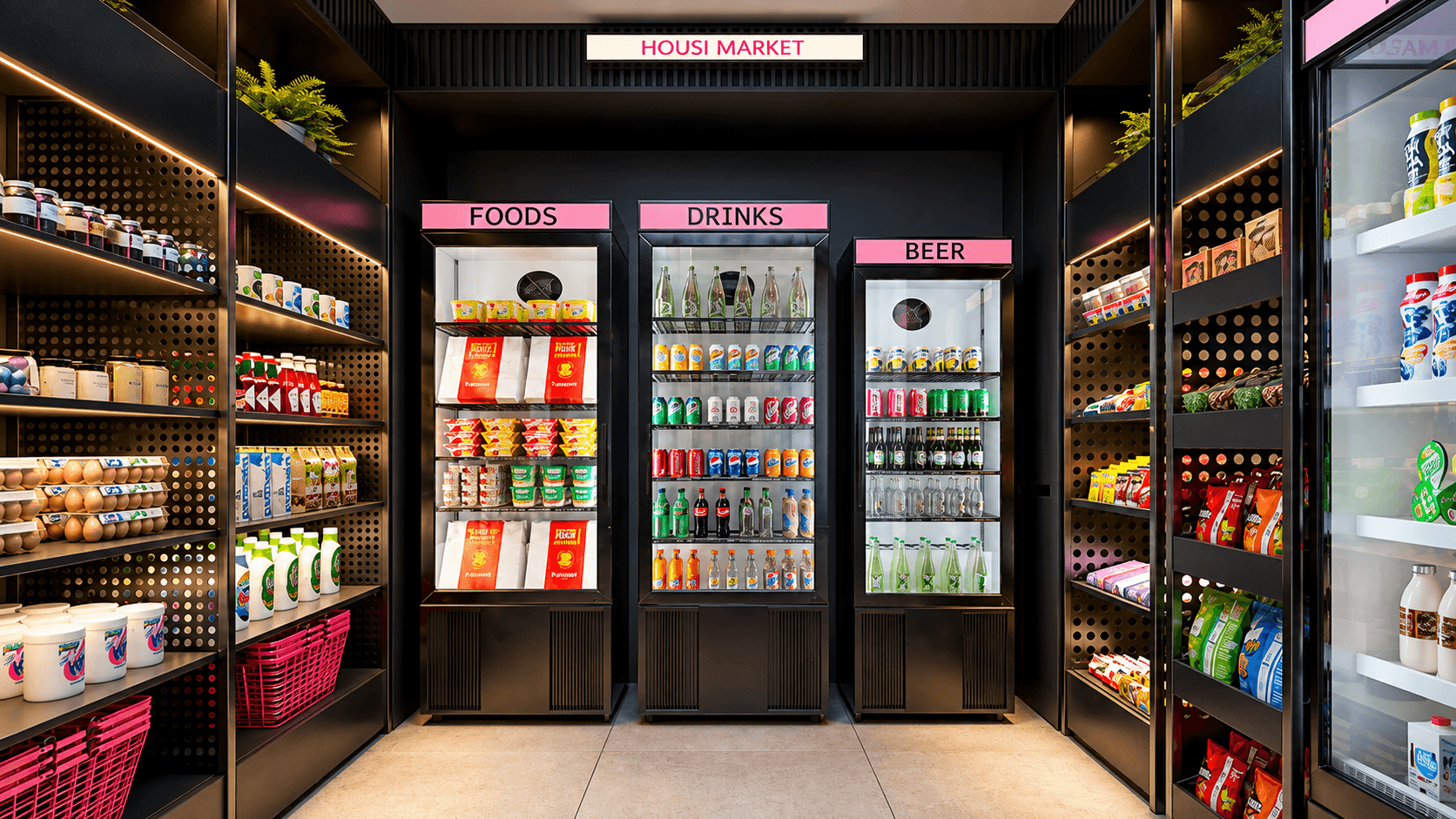
To understand the operational impact of this service, managers need to grasp how the condominium market works in practice, which is based on the global concept of honesty market or trust-based retail. It is a fully autonomous commercial structure, with no staff, tills or on-site attendants physically present within the building. Operation is entirely based on mutual trust and technological automation, where residents themselves choose products from the shelves, scan the barcodes and complete payment independently via a self-service digital kiosk (self-checkout) or a mobile app installed on their smartphone. This format ensures speed and privacy with every purchase.
The logistics behind the condominium market are controlled remotely by the operating company contracted by the management. Smart weight sensors, internet-connected security cameras working in real time and automated stock-control systems alert the company's central hub whenever a product reaches its minimum stock level. Based on this data, outsourced restocking teams carry out scheduled visits to the building to refill the shelves and fridges, ensuring residents always find fresh and varied products. All this logistical engineering happens without the building manager having to deploy their own staff or spend time overseeing the condominium market's stock.
The product range offered in a condominium market is customised according to each building's demographic profile and purchasing power. Shelves generally stock basic grocery items, cold drinks, dairy products, frozen goods, personal care products, snacks and even charcoal for weekend barbecues. Security is ensured by integrated closed-circuit television monitoring systems. Should any stock discrepancies or isolated thefts occur, financial and operational responsibility falls entirely on the partner company, sparing the general fund from losses caused by inventory shrinkage in the condominium market.
How to assess whether the condominium market genuinely interests residents

Although the convenience of having self-service retail just a few steps away may seem like an unanimously fantastic idea, the building manager should never sign an installation contract without first thoroughly assessing the community's genuine interest and social profile. Not every building has the quorum or consumption habits that justify installing a condominium market. Buildings with few residential units, for example, may not generate the minimum sales volume needed to attract serious companies in the sector, meaning the project could be born with a risk of early stock shortages or unexpected contract termination of the condominium market operation.
To obtain an accurate and democratic assessment of the condominium market's feasibility, management should carry out a broad sample survey using digital polls, printed forms or prior discussions in resident committees. It is essential to gather data on residents' shopping habits, how often they use delivery apps, and whether they feel the lack of a physical convenience structure in the common areas. This active listening prevents management from spending time and energy on an improvement that could be rejected or underused by most residents, ensuring the condominium market is implemented assertively within the building.
To help managers identify whether the building is ready to welcome this self-service retail innovation, we can highlight some practical feasibility indicators for approving the condominium market:
A high number of occupied residential units, ensuring a minimum daily flow of customers to sustain the condominium market;
A significant presence of families with children, young professionals with busy schedules, or older residents who prefer the condominium market;
Considerable distance from bakeries, pharmacies and traditional street shops, increasing reliance on the condominium market;
A high formal approval rate recorded in prior digital surveys about the arrival of the condominium market;
The existence of underused common areas that could house the physical structure needed for the condominium market.
Green flags: What to look for in well-structured companies in the sector
With the boom of this business model in the property market, hundreds of new operators have emerged promising miraculous advantages for building administrators. However, the building manager must take a careful, journalistic approach to separate established companies from opportunists operating in the condominium market segment. Identifying so-called "green flags" — clear signs of operational excellence and legal solidity — is the safest step to ensure the condominium market partnership brings only long-term benefits to the community, avoiding stressful contract breaches and chronic stock shortages.
A well-structured condominium market company first and foremost presents a solid portfolio of buildings served and checkable commercial references in its area of operation.
The ideal supplier should offer technical support and customer service twenty-four hours a day, seven days a week, both for residents facing issues with the payment kiosk and for the building manager in cases of infrastructure emergencies within the condominium market. In addition, a top-tier operator should hold valid insurance policies covering fire, electrical damage and civil liability, ensuring that any incident occurring on the condominium market's premises is independently covered by the company.
Another indispensable green flag is transparency in commission payments to the shared fund, where applicable, and the use of modern, data-driven stock-control technologies. Serious companies operating condominium markets carry out regular inspections to sanitise freezers, thoroughly check food expiry dates and continuously adjust the product mix based on resident feedback. Choosing a partner with these compliance standards raises satisfaction with the condominium market, turning the porter's lodge or entrance hall into a hub of operational excellence, food safety and continuous technological innovation.
Red flags: Warnings and risks when hiring condominium market suppliers
Just as there are highly qualified companies, the market also harbours suppliers that operate informally or without the technical structure needed to honour long-term commitments in running a condominium market. Building managers should watch out for "red flags" — serious commercial risk warnings — that indicate hiring that particular operator could bring serious legal, financial or health problems to the building. Ignoring these warnings when choosing a condominium market partner can turn a promise of convenience into a chronic headache for internal management.
The first major red flag is the requirement for exclusivity contracts with abusive lock-in periods combined with huge early-termination penalties for the condominium market. Companies that trust the quality of their logistics operation do not need to trap the client with suffocating contractual ties. Another extremely serious warning sign is the lack of proof of operating licences issued by the Health Surveillance Agency and the company's refusal to issue individual invoices for sales to consumers using the condominium market. Operating in tax informality exposes the administration to risks of joint legal liability before state regulatory bodies.
To protect the shared assets and avoid contractual pitfalls when assessing commercial proposals from operating companies, the building manager should map out the following warning signs about the condominium market:
Contracts with long-term lock-in clauses with no possibility of termination for poor service in the condominium market;
A recurring history of complaints about empty shelves or expired products displayed in the condominium market;
Use of old electrical equipment or exposed wiring that threatens the safety of the condominium market;
The operator's refusal to accept full civil liability for theft or damage occurring in the condominium market;
Lack of direct, responsive human channels for customer service and resolving billing issues in the condominium market.
Technical step-by-step guide to installing the structure in the building

The definitive implementation of a condominium market requires strict compliance with a bureaucratic and technical step-by-step process to ensure the improvement is born in full legal and operational compliance. The building manager cannot authorise the entry of equipment without the community's formal consent. The first step in this practical roadmap is convening an extraordinary general assembly of residents specifically to deliberate on the assignment of use of common area for autonomous convenience retail purposes, ensuring the legality of the condominium market.
The quorum required to approve the condominium market sparks discussion, but modern case law points to the need for a simple majority of the votes of those present at the assembly, provided the installation is considered a useful improvement that enhances collective quality of life without altering the primary purpose of the building's areas. Once approval is recorded in the assembly minutes, management moves on to the technical review of the draft contracts alongside the fiscal council and the administration's specialised legal advisers, defining each party's responsibilities within the condominium market.
To organise the transition between the idea and the actual operation of the self-service shelves in a fully structured way, building management should follow these essential steps to establish the condominium market:
Approval of the project at a general assembly of residents with formal record in the official minutes regarding the condominium market;
Signing of the loan-for-use or lease agreement for common area space with the condominium market's supplier company;
Verification and issuance of all tax compliance certificates and health licences to operate the condominium market;
Adaptation of basic infrastructure points, such as dedicated power outlets for the condominium market's fridges;
Wide dissemination of the operating rules, restocking schedules and support channels for the condominium market.
Strategic criteria for finding the ideal location for the condominium market
Choosing the exact geographic spot within the building to house the condominium market structure is one of the most decisive factors for the initiative's commercial and operational success. A poorly planned, hidden or hard-to-reach location will make residents forget the service exists, resulting in low sales volume and the consequent loss of interest from the operating company in keeping the condominium market's shelves regularly stocked, jeopardising the long-term partnership.
The primary criteria for choosing the location should prioritise visibility, the natural flow of residents and the logistical ease of restocking the condominium market. Areas near the main entrance hall, covered recesses near the residents' lifts, disused games rooms or underused spaces near the security lodge are the locations most recommended by experts for installing the condominium market. The space must be fully covered and protected from the elements, such as direct rain or excessive sun exposure, which can damage food and overheat the condominium market's drink fridges.
Beyond convenience for internal customers, the building manager must assess the architectural accessibility of the chosen space to ensure wheelchair users, older residents and people with reduced mobility can use the self-service kiosk without physical barriers in the condominium market. The location chosen for the condominium market should also ease the loading and unloading route for restocking teams, preventing external delivery staff from having to pass through restricted or highly private family areas, preserving the organic security of the whole building while enjoying modern, well-stocked retail.
Physical infrastructure: The condominium market's impact on electricity consumption
Although condominium markets are usually installed under loan-for-use models — where the partner company supplies the shelving, digital kiosks and appliances at no purchase cost to the building's fund —, the building manager needs to be aware that this structure generates an ongoing indirect financial impact: the increase in electricity consumption in the common areas. Keeping commercial drink fridges, upright freezers, routers and LED lighting systems running twenty-four hours a day permanently raises the electricity demand on the main meter because of the condominium market.
This new electricity consumption generated by the condominium market is billed to the building's common-area meter. Depending on the contractual arrangements made during the planning stage, the operating company may pay a fixed space-rental fee or pass on a percentage of monthly sales as a commission, thereby offsetting the extra electricity cost generated by the condominium market's refrigeration equipment. The building manager should monitor this electricity consumption closely to ensure the condominium market project remains financially viable and worthwhile for the community.
Overlooking the electrical load of multiple commercial refrigeration motors running non-stop in the car park or hall can lead to unpleasant surprises when the monthly accounts are closed. Therefore, the search for innovative efficiency and tariff-optimisation solutions is no longer just a nice environmental goal but has become an urgent administrative duty for the building manager who decides to modernise the common areas by installing a condominium market, combining retail technology with financial intelligence on energy costs to keep the shared fund financially healthy.
NewSun Energy: Clean energy subscription and predictability for the condominium

As managers and board members seek to modernise building infrastructure with cutting-edge amenities and cope with the new electricity costs generated by innovations such as the condominium market, the overall management also needs to find smart alternatives to optimise the fixed expenses of shared common areas. To achieve maximum energy efficiency and bring absolute financial stability to the building's shared fund, NewSun Energy Group presents a revolutionary clean energy subscription model designed specifically for the modern property market and condominiums.
NewSun's clean energy subscription works as an innovative solution that stabilises the electricity bill for the building's common areas, comfortably absorbing the electrical impact caused by the running of the condominium market's fridges and kiosks. By joining this sustainable renewable-source system, the management secures direct discounts on its traditional energy bill in a completely hassle-free way, with no need to invest in construction work or install expensive solar panels on the building's premises. The great advantage of this smart solution is that it fully shields the building's bill against the severe financial impact of yellow or red tariff-flag fluctuations during dry periods, delivering progressive, sustainable savings throughout the contract.
Alongside the real, guaranteed financial savings achieved through the subscription, NewSun Energy Group stands out in the national electricity sector by offering genuinely human, close, responsive service focused on the building manager's real needs. Building management also gains exclusive access to the NewSun Energy Club digital platform, a modern management tool developed for detailed, transparent monitoring of the building's entire energy consumption and spending profile. Through NewSun Energy Club, the manager tracks electricity indicators in real time right from the palm of their hand, combining digital innovation with sustainability to boost the financial health of the ordinary budget and enable every new modernisation project, including the success of every condominium market installed intelligently.
Find out how the Clean Energy Subscription.
Legal aspects, compliance and rules of use in the building bylaws
The day-to-day operation of a condominium market involves a range of legal responsibilities and compliance rules that must be properly set out in the building's internal regulations to avoid conflicts among residents or civil liability proceedings against the management. The building manager must understand that, as this is a commercial space within a private residential area, there are clear regulatory limits that must be respected both by the operating company and by the residents who use the condominium market.
One of the most sensitive legal points concerns the sale of and access to alcoholic beverages and restricted products within the condominium market. To strictly comply with the provisions of the Child and Adolescent Statute prohibiting the sale of alcohol to those under eighteen, the contracted company must implement rigorous technological locks within the condominium market. This includes smart fridges that only open after scanning an ID document proving the user's age, or app systems that require facial biometrics and prior registration of responsible parties before releasing alcoholic drink purchases in the condominium market.
To build a safe, ethical and fully legally compliant self-service environment, the internal regulations update drafted by management should contain the following essential compliance rules for the condominium market:
Explicit prohibition on the immediate consumption of food or opening of drink packaging within the physical space of the condominium market;
Full civil liability of the operating company for any damage or stock loss occurring in the condominium market's equipment;
Technological camera-monitoring mechanisms to identify users who breach the condominium market's rules;
Clear definition of the permitted hours for outsourced teams to carry out stock restocking at the condominium market;
Mandatory upkeep of health licences and invoices clearly issued by the condominium market's company.
The condominium market's impact on property value appreciation
Investing in a modern, secure and well-stocked condominium market has a direct and extremely positive effect on the market value of every residential unit in the building. Today's property market is highly competitive, and prospective buyers look for properties offering total convenience, where the shared infrastructure can meet daily needs for convenience, leisure and safety without families having to go out into the city streets, highlighting the role of the condominium market.
The presence of self-service amenities acts as a powerful marketing differentiator to attract investors and qualified new residents to the building. Estate agents highlight the presence of a condominium market as a strong selling point, demonstrating that the building has adopted automation and cutting-edge technology solutions to boost its occupants' well-being. This perception of modernity and practicality raises the liquidity of the flats, allowing owners to secure more favourable and faster deals when selling or letting properties equipped with a condominium market.
Beyond the marketing appeal of self-service retail, the condominium market transforms the living experience, adding intangible value linked to quality of life and time savings. Knowing you can pick up a basic food item in the middle of the night without leaving the building's monitored security raises overall satisfaction with the management. This modernisation of the shared infrastructure cements the shift towards the smart-living model, where the proximity technology and self-service retail of the condominium market work in complete synergy to protect, add value to and simplify the daily routine of every resident family.
Strategic decisions to modernise management and community life
Successfully completing the implementation of a condominium market marks a watershed moment in the administrative modernisation led by the current building manager. Bringing proximity retail and self-service technological innovations to a residential setting is a clear demonstration of leadership in tune with contemporary demands for convenience, useful time and safety. Although planning and choosing the supplier require technical rigour to avoid commercial red flags, the benefits generated by the condominium market fully justify the effort of the organising committee and the board.
By aligning the practicality of self-service retail with the financial intelligence of adopting innovative electricity-efficiency solutions, such as the renewable energy subscription supplied by NewSun Energy Group, the manager creates a sustainable administrative model with strong financial performance. The success of the condominium market is secured when building management monitors electricity consumption, oversees the range of products offered to residents and maintains transparent channels of communication with the community, turning the common areas into a lasting hub of innovation, practicality and long-term property value for everyone.
You may also like
- Casos de Sucesso
 20/10/2026
 5m
5m - Dicas para Síndicos e PMES16/10/20265m
- Dicas para Síndicos e PMES13/10/20265m




Stop paying more for your energy bill
Find out in less than 1 minute how much you could save with clean energy every month — no works and no bureaucracy.
Join the energy revolution
Subscribe to our newsletter and receive exclusive content